P4P is easiest to misunderstand if you stop at the front page.
If you only see Pizza4People, it can look like another attempt to build a restaurant app:
a new brand, a new menu, a new ordering surface, another interface trying to sit between the customer and the restaurant.
That reading is understandable.
It also misses the point.
What matters in P4P is not the existence of a pizza site.
What matters is the split behind it.
P4P is trying to separate things that platforms usually keep collapsed together:
- public discovery - public module reading - local restaurant control
That is why it now makes more sense as a structure than as an app.
The Front Page Is Only the First Layer
Pizza4People is the public proof surface.
It has to exist because a project like this needs a visible public face. Someone has to be able to see the claim, open the site, and understand what kind of thing is being built.
But if that surface stands alone, P4P is easy to misread.
Then it looks like a better-branded version of the same old stack:
a nicer marketplace, a lighter backoffice, a more independent-looking middleman.
That is not the real direction.
The real direction becomes clearer only when you look at the other layers that now exist beside the front page.
There is a public module-reading layer.
And there is a local node.
That matters because a system like this should not only be visible.
It should be readable.
Public Proof, Public Reading, Local Control
P4P is easier to explain now because it has started to show its own layers.
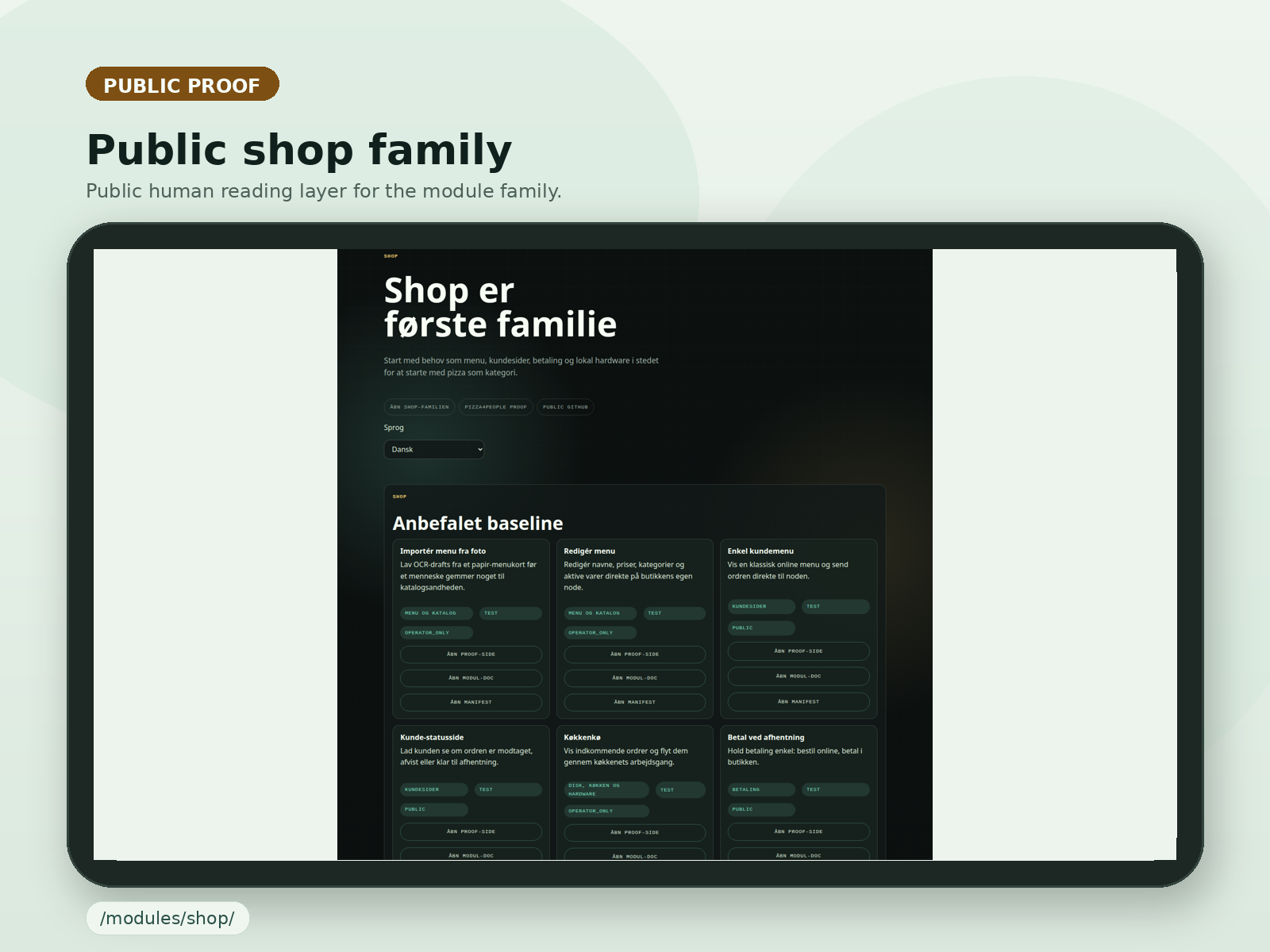
The first layer is Pizza4People: the visible face, the first narrow claim, and the public argument that restaurant discovery and direct ordering do not have to begin inside a closed platform.
The second layer is Protocols4People.
That is where the module system starts to become readable in human language. Not as an app store yet. Not as a full install-and-update marketplace. But as a public catalog of what modules are for, how they group together, and what kind of node they belong to.
That sounds like a small change.
It is not.
A lot of technical projects stay trapped inside their own repo. The architecture lives in code and in the heads of the people building it. Everyone else sees only a product pitch or a vague diagram.
The public module catalog is a move away from that.
It says the system should be understandable before someone reads a manifest file.
The third layer is the most important.
That is the node.
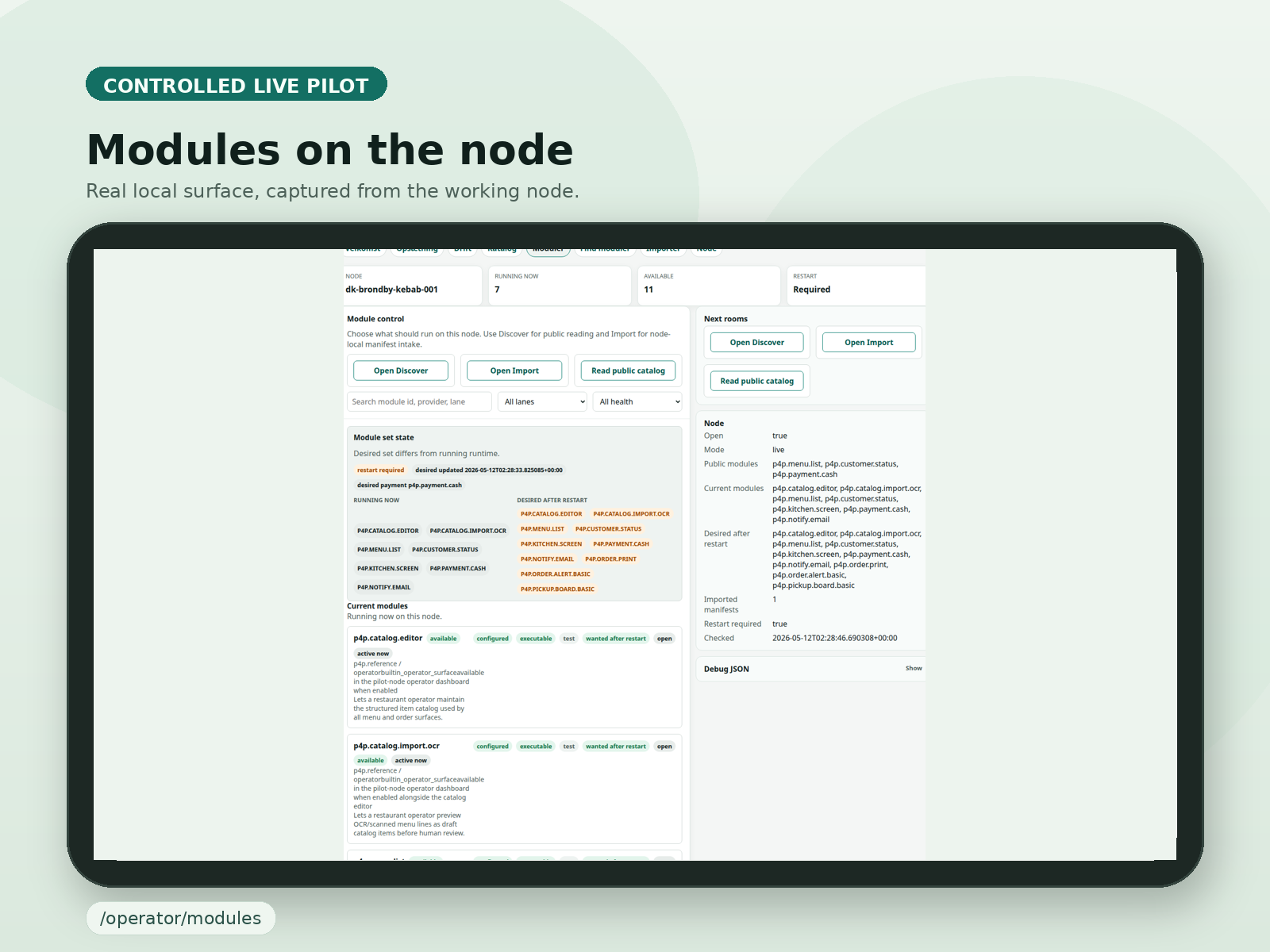
This is where the menu lives. This is where local operations live. This is where the operator can see which modules run now. This is where the operator can see which modules are desired after restart. This is where a local or external module manifest can be imported without pretending it is already safe, runnable, or production-approved.
This is where the project starts to make more sense.
The Node Is the Real Argument
The local node is not just a technical detail.
It is the point of the split.
If discovery, menu, order state, payment buttons, notifications, status, hardware, and operator control all collapse into one central platform, then the restaurant may have convenience, but it does not really have control.
It rents access to the relationship.
That is the dependency P4P is trying to weaken.
The claim is not that every restaurant should become its own infrastructure company.
The claim is that the base relationship should not have to be owned by the same actor that wants to sell everything above it.
That is the difference between a registry helping a customer find a restaurant and a platform owning the restaurant's entire digital existence.
The first is a door.
The second is the whole house.
P4P is trying to keep that distinction visible.

Why the Operator Work Matters
This is why the operator screenshots matter more than they might look at first glance.
Not because they are pretty.
Because they make the argument inspectable.
When you see rooms like `Operations`, `Catalog`, `Modules`, `Discover`, and `Import`, you are not just seeing local UI polish. You are seeing a proposed division of responsibility.
`Catalog` says the menu should be local.
`Modules` says the runtime shape of the node should be visible, adjustable, and restart-truthful.
`Discover` says public module reading and local module activation should not be the same thing.
`Import` says a node can become aware of homebuilt or external module manifests without pretending that awareness is the same as trust, execution, or production safety.
That is not how normal platform backoffices are designed.
A normal platform backoffice is usually just the other side of the same central machine.
The operator node is trying to be something else:
a restaurant-owned operating room on top of a more open discovery layer.
That distinction is still incomplete.
But it is no longer only theoretical.
Why Modules Matter
The module layer matters because it keeps the structure visible.
If everything is described only as a feature of one product, the real shape disappears.
Catalog editing becomes a feature. Customer status becomes a feature. Kitchen flow becomes a feature. Cash becomes a feature. OCR import becomes a feature. Notifications become a feature.
Once everything is just a feature, it becomes much easier for one ownership layer to quietly absorb all of it.
Modules make that harder.
They make it clearer that the system is not one monolith pretending to be neutral.
They make it clearer that different layers can be swapped, deferred, delegated, or kept out entirely.
That applies to payment. It applies to hardware. It applies to local shop shape. It applies to future trust layers. And it applies to future nodes that may not look exactly like the current reference node.
That is why Protocols4People matters too.
It gives the module layer a public language instead of leaving it trapped as code.
What P4P Still Does Not Claim
This only works if the boundaries stay honest.
P4P is still not a finished restaurant platform.
It is not broad live operations. It is not proven support. It is not solved delivery. It is not solved refunds. It is not a finished trust layer. It is not a claim that everything is ready just because the screenshots look more real now.
The screenshots matter only if they make the boundaries clearer.
They should show that the system has become more legible.
Not trick anyone into thinking that legibility is the same thing as production maturity.
That is the line worth protecting.
The Better Explanation
So maybe the better explanation of P4P now is not:
here is a new restaurant app.
It is this:
here is an attempt to make the connection between restaurant and customer more readable, more local, and less captured.
Not by pretending commercial services disappear.
Not by pretending all centralization is evil.
Not by pretending a prototype has already solved the whole market.
But by showing that discovery, control, and modules do not have to live in the same ownership surface.
That is not the whole solution.
But it is a much better description of what P4P is actually trying to become.
Explore the layers
- Pizza4People for the public proof surface
- Protocols4People / shop for the public module-reading layer
- P4P on GitHub for the build and reference surface