The website starts to look like something.
That is the part that scares me.
Not because it is finished. It is not. The front page is still changing. The article footer only just learned how to open. Lineage is visible in one layer and not yet in all the ways it needs to be. DeepAsk is still waiting for its real public contract. There are rough edges everywhere.
But something has changed.
The site no longer feels like a place where I put articles after thinking.
It has started to become one of the ways I think.
That is a small interface update if I describe it badly.
It is a larger personal event if I describe it honestly.
For months I have compared Hedegreen Research to other things. Bellingcat was there early: open sources, public method, evidence that could be checked. Gwern was there too: a personal website that becomes more than a website because the work stays connected over time. Then came OpenStreetMap, Mozilla, Internet Archive, Our World in Data, old think tanks, Tactical Tech, Data & Society, The Markup, ProPublica, old web pages, hobbyist spaces, music rooms, notebooks, forums, strange little personal domains that did not ask a platform before they existed.
Each comparison helped.
Each comparison also failed.
Bellingcat gave me a standard for traceability, but Hedegreen Research is not only investigation. Gwern gave me a way to imagine a personal research archive, but Hedegreen Research is also tools, reports, public logs, music, relations, and small systems. OpenStreetMap and Mozilla gave me infrastructure language, but this site is not a foundation. Think tanks gave me system-analysis language, but I do not want to borrow the tone of institutions that already know where the conclusion should land.
At some point the comparisons stopped answering the question.
They only showed me why I kept asking it.
I think I have been asking for permission to have a view.
Not formally. No one was standing at the door with a stamp. But something in me kept waiting for a safer role. A school. A title. An editor. An institution. A category that would make the sentence allowed before I wrote it.
That is strange, because I did have a public language once.
When I was younger I was around political rooms, demonstrations, Ungdomshuset, COP15, arguments, causes, people who believed sentences should leave the body and meet the street. I knew what it felt like when a position had somewhere to go.
Then, at some point, I withdrew.
I do not think I stopped caring. I think the argument moved inward.
For years I argued with myself from every angle. Every claim had a counterclaim before it had even left my head. Every instinct was cross-examined by another version of me. Sometimes that looked like nuance. Sometimes it was fear.
Then language models arrived.
And suddenly the internal argument had a machine attached to it.
That could have made everything worse.
In some ways it did. A loop can become very convincing when it has infinite patience.
But it also gave the argument a surface. It made it possible to test a sentence, attack it, rewrite it, build a tool around it, turn it into a public object, and then see whether it still held up after it left my head.
Hedegreen Research did not begin as an institution.
It began as a way to survive my own overgrown internal debate without pretending the debate was finished.
That is why the website matters to me in a way that a normal redesign would not.
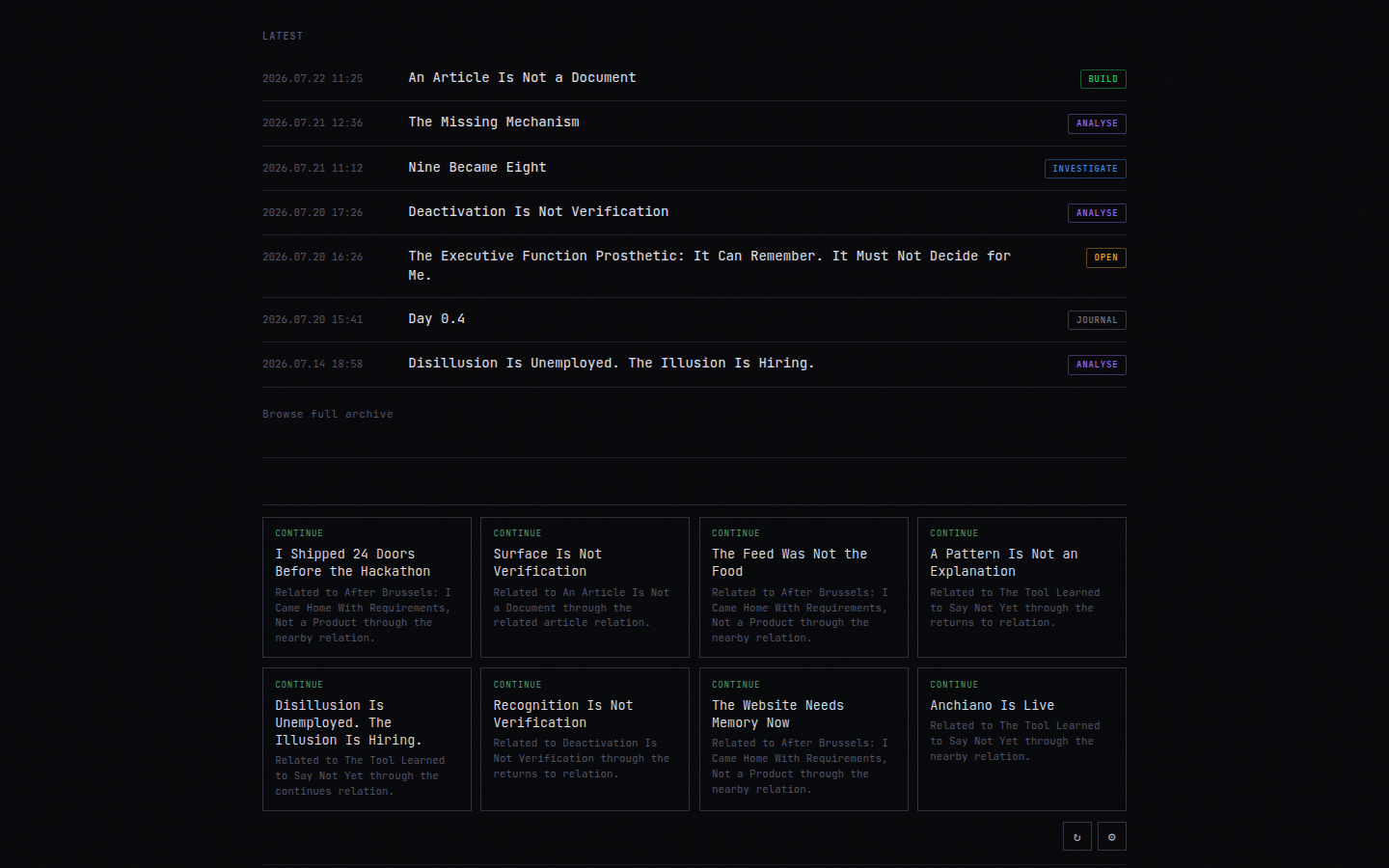
The new front page is not only a list of recent articles. It can now respond to what a reader has marked as read in their own browser. No account. No tracking. No hidden profile sent back to me. Just local memory, sitting on the reader's side, letting the site choose different doors when the reader has already entered through others.
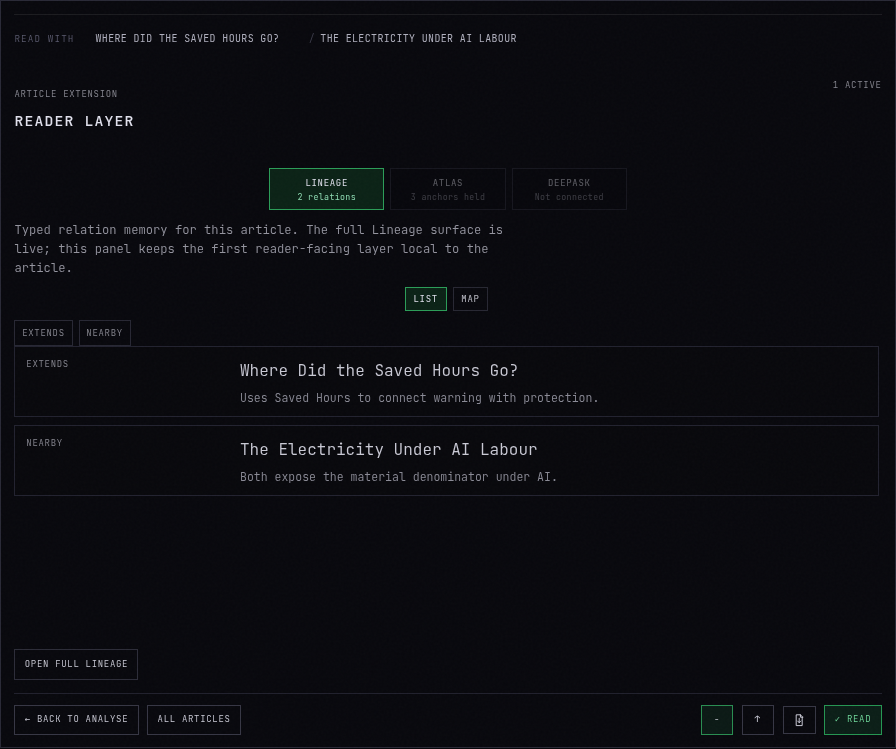
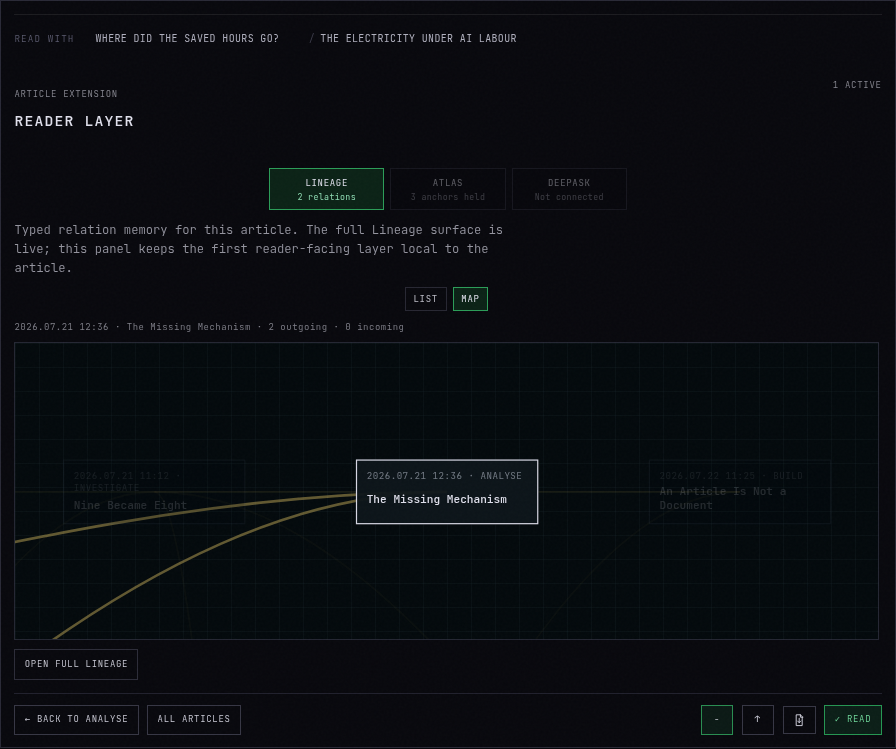
The article footer is no longer only a place to leave. It can open. It can show Lineage. It can keep Atlas and DeepAsk as future layers without pretending they are already alive. It can say: this article is not alone. It has relations. It continues something. It pushes against something. It sits beside something.
That sounds technical.
It is technical.
But it is also a change in public posture.
For a long time I wrote like someone trying to prove that a thought deserved to exist. Now the site is beginning to arrange the work as if the question is not whether I am allowed to think, but whether the work can be followed.
That is different.
I do not need permission to build the surface.
I do need permission before I borrow anyone else's authority.
That line matters more now than it did a few months ago.
Hedegreen Research has started to collect authority-signals whether I like it or not: articles, tools, PDFs, DOI-bearing work, public logs, local memory, Lineage, outreach, replies from people who know more than I do. That can become dangerous if I use it badly.
If someone replies to a research email, that is not an endorsement.
If a tool receives methodological criticism from outside, that does not make me an authority.
It means the surface was concrete enough to be corrected.
That is the kind of authority I can live with.
Not authority as a voice above the reader.
Authority as a claim made visible enough that someone can point to the weak part.
Maybe that is why I have moved from the street to the paper without feeling like I left politics behind.
A demonstration says: this matters.
A paper says: here is the structure.
A tool says: try the assumption yourself.
An email to a researcher says: please tell me where this breaks.
Those are different surfaces. They are not the same act. They do not reach the same people. But they can belong to the same political life.
I did not stop being political.
I stopped accepting the menu.
I can agree with one side about power, labour, ownership, and the cruelty of market discipline. I can agree with the other about responsibility, local life, institutional failure, and the danger of systems that make people passive. But the old split often feels like a machine that sorts people before it lets them describe what they have seen.
So I made my own working surface.
That does not mean I have made a finished worldview.
It means I have stopped waiting for the old boxes to authorize a better question.
If there is a movement here, I am not standing above it.
I am not the movement.
I am one blade of grass trying to build better roots.
If the site became a surface for my own unfinished argument, DeepAsk asks whether that surface can be shared without pretending disagreement has disappeared.
DeepAsk belongs in that future, if I can make it honest enough. Not as a chatbot that pretends to settle disagreement. Not as a poll that turns people into percentages. A way for many people to enter the same public question from different places, leave a trace of what they meant, and receive a receipt for what happened to their input.
That is still future work.
For now, the website itself has started to practice.
It remembers locally.
It opens relation layers.
It lets the reader enter through their own path.
It begins to show the system without asking the reader to worship the system.
This is where the comparisons can finally relax.
Hedegreen Research does not have to be Denmark's Bellingcat. It does not have to be Gwern with a darker interface. It does not have to be a think tank, a lab, a foundation, a newsroom, a zine, an old forum, a Signal room, a public-interest technology project, or a civil version of some fictional network operator.
Those comparisons helped me find edges.
They do not have to be the permission slip.
Not everyone needs to build a research archive. Not every personal website has to become a tool surface. But the internet should still have room for people to build strange, long-term public things before they become companies, brands, institutions, or content machines.
I am not suddenly becoming powerful tomorrow because a footer can open and a homepage can sort eight article doors.
I am still a hobbyist with a website, a pile of tools, too many questions, and a strange amount of joy in making the pieces connect.
Serious work does not have to pretend it is joyless.
Maybe one of the reasons I kept going is simpler than all the theories:
I like building this.
Maybe the internet should still have room for that.