The safety infrastructure between a prescription and a person
A pharmacy can already have a robot in its back room finding medicine.
That is not science fiction. It is ordinary infrastructure.
The harder question begins after the robot has found the box.
How does a prescription remain connected to the right physical medicine, the right person, the right moment, and the actual outcome when the work is distributed across systems, people, rooms, deliveries, interruptions, and exceptions?
That is the last meter.
Not one metre in a literal hallway. The last chain of handoffs where a medication record, a physical dose, a human being and an act of care have to agree.
The idea is not a cabinet
I began with a concrete idea: a local station supplied by controlled medicine sources. A worker would identify themselves. The system would identify the resident and check the current medication state. Only the permitted physical sources would be available for that transaction. Exceptions would not disappear; they would have their own visible path.
The visual image was a cassette station.
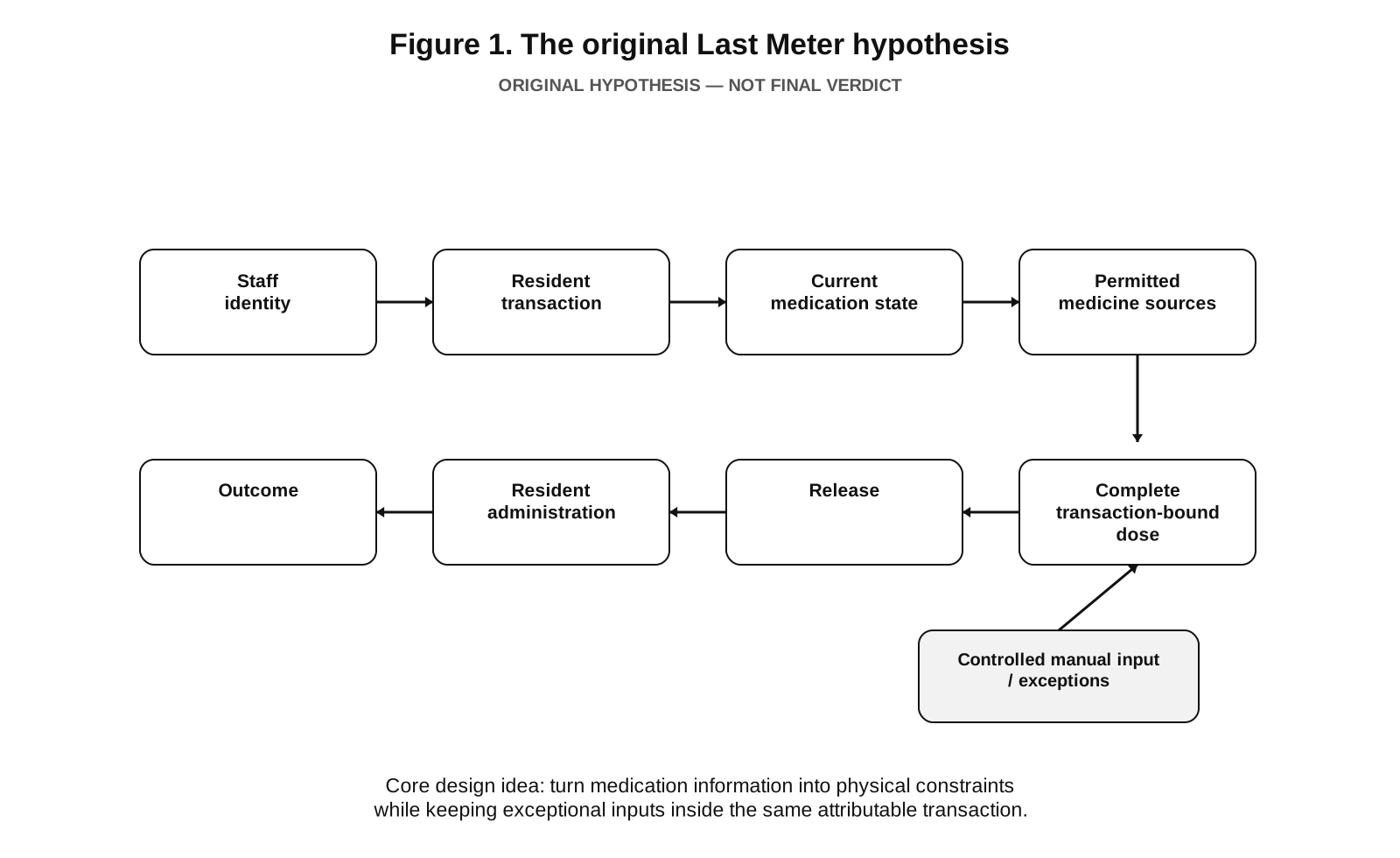
But the cassette is not the point.
The point is to make certain dangerous mismatches harder to perform. To reduce the amount of responsibility that sits only inside one tired person’s head at the exact moment that something is missing, changed, late, interrupted, or unclear.
The same underlying problem could matter if medicine arrives from a pharmacy robot, a locked carrier, a local dispenser, a delivery service, or a future distribution system we have not built yet. A remote delivery network may move a package efficiently, but medicine cannot be treated as an ordinary package. It needs to preserve a chain:
current medication state → physical medicine → intended person → administration or delivery → recorded outcome
If that chain breaks, speed is not safety.
Existing infrastructure matters
Denmark does not begin from nothing. Medication safety already includes the Shared Medication Record, local electronic medication records, dose packing, patient-specific labelling, procedures, identification routines and administration documentation.[1][2][3][4]
That matters because a serious idea must first ask what already exists.
Existing controls may remove much of the reason for a new machine. Dose packing can reduce manual preparation. Barcode and patient-specific systems can support matching. Locked or controlled delivery can constrain access. Automated dispensing has its own evidence, limitations and failure modes.[13][14][15][17]
So this is not an article claiming that no one has thought about medication safety before.
It is an article asking whether existing controls always keep the relevant things bound together when they pass between systems and people.
Inspection and incident material show why the question is worth taking seriously. Medication-handling deficiencies have been identified in inspected Danish care settings, and documented cases show mechanisms such as a changed medication state, a dose intended for the wrong person, and complications around dose dispensing.[1][2][6][7][8][9][16]
Those sources do not tell us how common every failure is across Denmark. One incident can show that something can happen. It cannot show that it usually happens.
But it can tell us where to look.
The research changed the idea
The first version of the concept was too confident.
It treated the last physical step as though it were the main origin of medication harm. It treated a cup or container as too close to being proof of identity. It assumed that cassette data could stand in for proof of the actual medicine delivered. It imagined that one generic override could handle real life.
Those assumptions did not survive pressure.
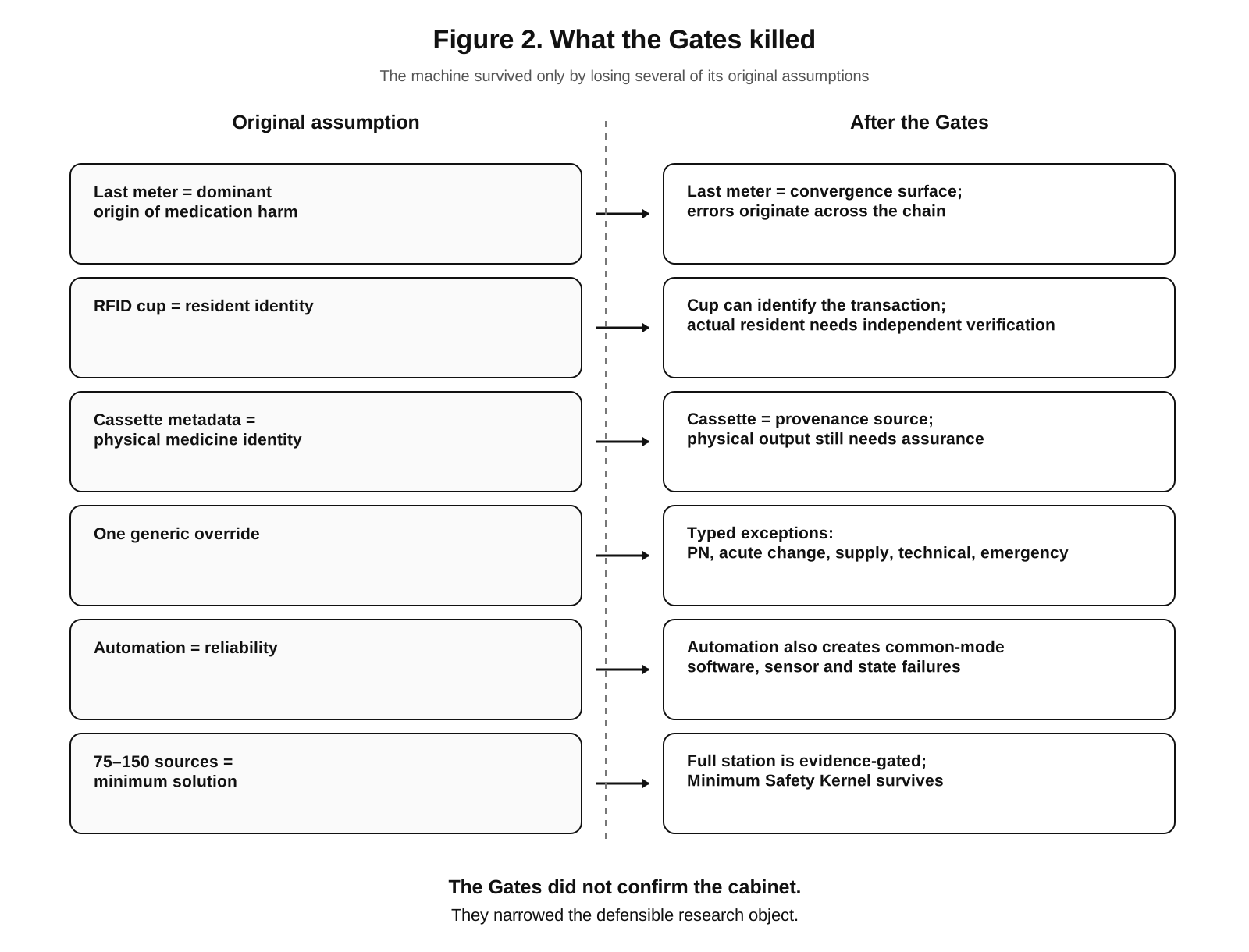
Medication problems can begin upstream, long before administration. A perfectly enforced bedside process cannot repair an incorrect medication state. A container is not the person. Metadata on a source is not proof of the final physical dose. Exceptions are not one thing; they include refusals, changes, missing medicine, urgent needs, substitutions, delayed delivery, and deviations that must be reconciled rather than hidden.
Automation can also create new failure modes. Recall material for existing dispensing systems is a useful warning: a machine can be wrong at scale, hide a state problem, or make a faulty action easier to repeat.[10][11][12]
That does not make automation pointless.
It means a machine needs a safety case, not just a nice interface.
What survived
The research did not prove that a full cassette station should be built. It did not prove that it would be safer than existing dose packing or other controls. It did not settle who would be legally responsible at every handoff, what could be transported, or what device classification might apply.
But the core question survived:
Can a medication system preserve an explicit, independently checkable connection among the current medication state, the physical medicine, the intended person, exception states, and the recorded outcome?
The Infrastructure Gaps work calls the remaining problem a partial gap. That is not an official diagnosis. It is a project judgement: many of the pieces already exist, while the connection between them can still be lost across handoffs.
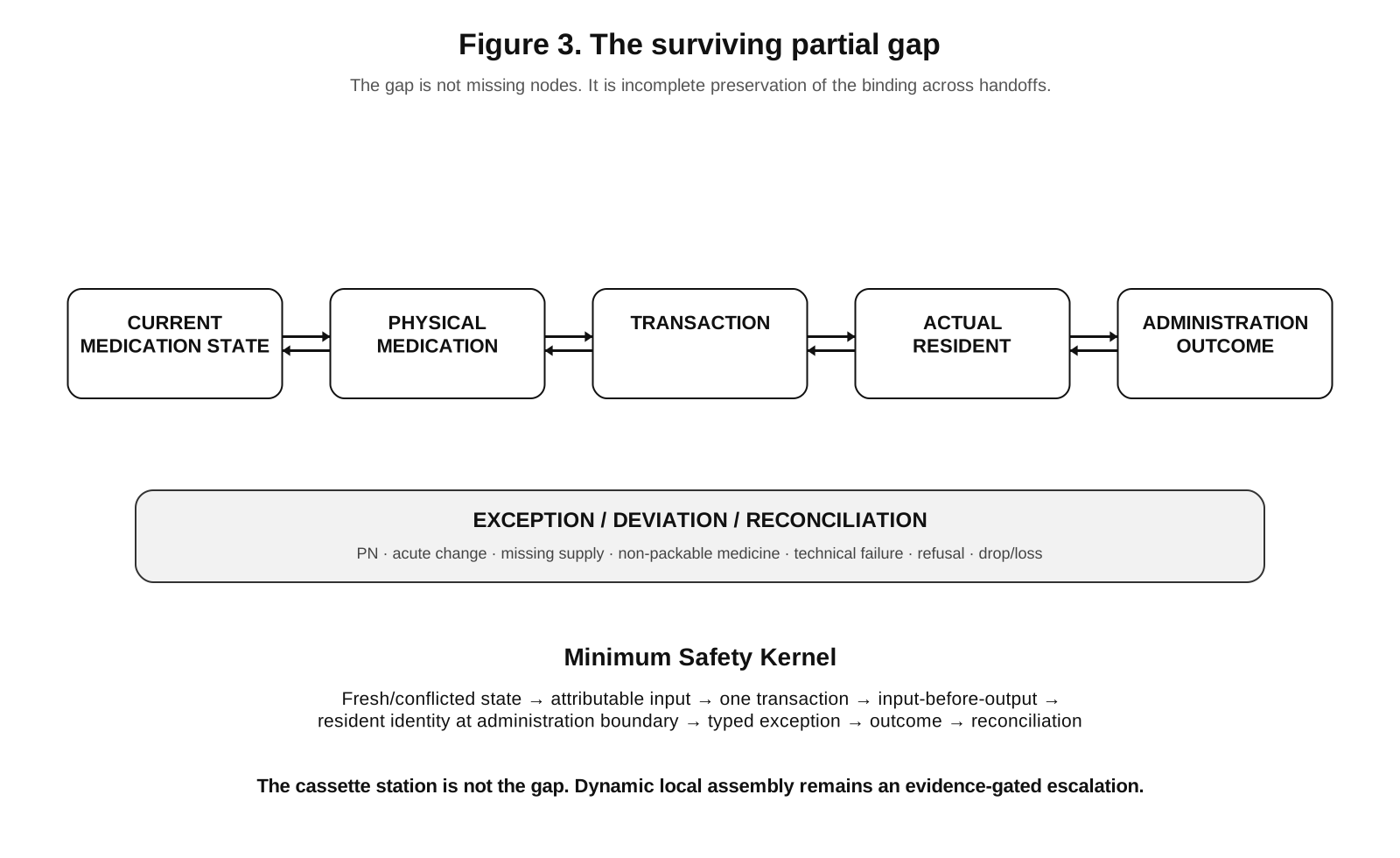
The original station is therefore not dead. It is evidence-gated.
That is an important difference.
An abandoned idea is one we stop caring about. An evidence-gated idea is one we care about enough to stop pretending we already know the answer.
What frontline feedback is for
I have received informal feedback from six social and health care assistants. All of them reacted positively to the possibility of carrying less medication responsibility and having more support around the work.
That is not a study. It does not prove that the idea works, that every worker agrees, or that any design would reduce error.
It does make the next question more concrete.
What responsibility are workers carrying today? At which moments do they have to rely on memory, improvisation or repeated checking? Which exceptions create the most uncertainty? What would support feel like without becoming surveillance, extra administration, or a new source of blame?
Those are questions to ask with workers, pharmacists, residents, relatives and safety specialists—not questions to answer for them with a product render.
A wider future still has a last meter
It is easy to imagine future delivery infrastructure as a convenience story: a tube system for packages and food, autonomous vehicles, locked handover points, robots that carry supplies, remote support.
The important question is not whether those systems can move objects.
It is whether they can keep responsibility and reality connected.
For medication, a future transport system needs more than a route. It needs identity, custody, reconciliation, a safe exception path, and a way to escalate to a human being when the system does not know enough.
The same principle appears elsewhere. A support robot for a person in distress might offer a calm connection to help, notice an acute danger, and call a human. It should not pretend that it can replace care, consent, clinical judgement or a real relationship.
Technology becomes useful here when it makes dangerous situations less lonely and less dependent on perfect behaviour under pressure.
The next research is not a prototype
The next step is a field denominator.
Before anyone claims that a local station is needed, we need to see the real work: how many transactions are already handled by dose packing or other controls; how often manual and exceptional work remains; where reconciliation happens; where responsibility changes hands; and which failure modes are actually plausible.
That should be followed by structured conversations with people who do the work, and by a pharmacy and safety review of packaging, transport, tracing, accountability and failures.
Only then does it make sense to ask what form an intervention should take.
Maybe it is a cassette station. Maybe it is a smaller Minimum Safety Kernel. Maybe it is better integration between systems that already exist. Maybe the evidence shows that the original idea is wrong in a useful, specific way.
I do not know yet.
But I would rather investigate that properly than dismiss an idea just because the first version was too large.
— Dennis Hedegreen, follow the data
Evidence notes
The following sources were reviewed on 26 August 2026. Inspection, incident and enforcement sources are used as mechanism evidence, not national prevalence. International studies are comparators, not direct evidence for a Danish Last Meter intervention.
- Styrelsen for Patientsikkerhed, Tilsyn på plejeområdet viser fortsat udfordringer med medicinhåndteringen, 2025.
- Styrelsen for Patientsikkerhed, Sundhedsfaglige tilsyn med medicinhåndtering 2023–2024, 2025.
- Styrelsen for Patientsikkerhed, Standardmålepunkter på tværs af behandlingssteder.
- MedCom, Dosisdispensering.
- MedCom, Dosispakket medicin — statistik.
- sundhed.dk / Region Nordjylland, Manglende opdatering af FMK, 2026.
- sundhed.dk / Region Syddanmark, UTH cases, 2025.
- Styrelsen for Patientsikkerhed, Læsø Plejehjem, 2026.
- Styrelsen for Patientsikkerhed, Svane Pleje København, 2026.
- U.S. Food and Drug Administration, BD Pyxis MedBank/MedPass recall, 2025.
- U.S. Food and Drug Administration, BD Pyxis MedBank MedPass Software recall, 2023.
- U.S. Food and Drug Administration, BD Pyxis MedStation ES recall, 2023.
- Szczepura A, Wild D and Nelson S, Medication administration errors for older people in long-term residential care, BMC Geriatrics, 2011.
- Vogelsmeier A et al., Medication Identification Device to Reduce Medication Errors in Nursing Homes, Journal of Gerontological Nursing, 2022.
- Hänninen K et al., Automated unit dose dispensing systems producing individually packaged and labelled drugs for inpatients, European Journal of Hospital Pharmacy, 2023.
- sundhed.dk / Region Nordjylland, Pausering ved dosisdispensering.
- Black A et al., Impact of automated dispensing solutions in long-term care facilities and closed-door pharmacies, Journal of the American Pharmacists Association, 2024. The paper reports author conflicts connected to BD.