From Forest to the Future
Earlier today I was in a forest in Sweden with Silas and someone I love.
It was one of those hours that belongs completely to the physical world.
Trees.
Wet ground.
Cold air.
No system.
No dashboard.
No build log.
Tonight I came home and sat in front of a text interface for five hours without opening a browser.
That has never happened before in my life.
No tabs.
No feeds.
No documentation spiral.
No false sense of progress from moving things around on a screen.
Just text.
Just local files.
Just a machine on the other side that could keep the thread alive while I worked.
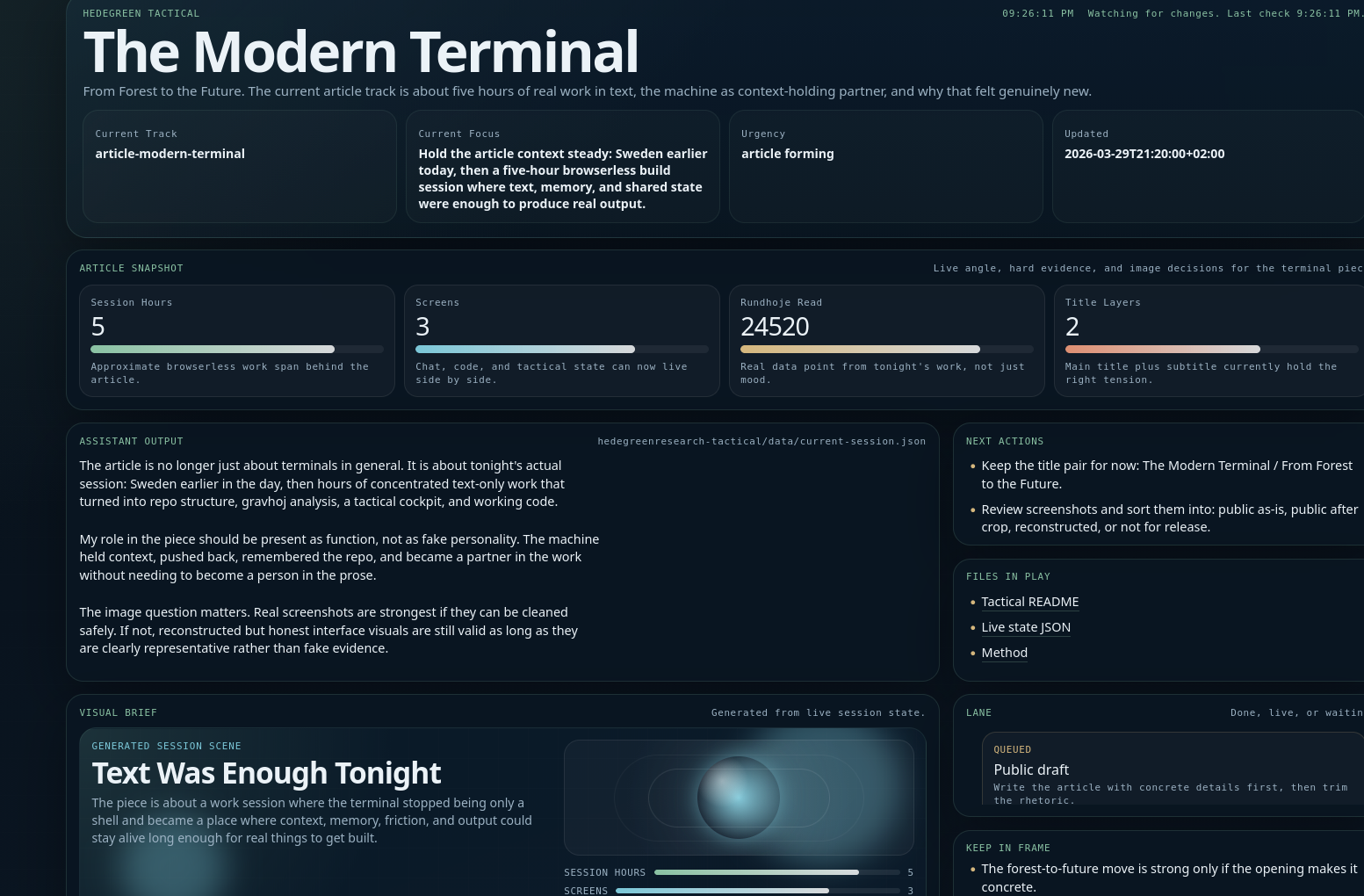
The old terminal assumed something very specific.
That you already knew the command.
You were supposed to arrive with the move. The machine executed or refused. If you were lost, it stayed lost with you.
What I sat in front of tonight was still text. Still input and output. Still more austere than a normal application.
But it did not behave like the old thing.
It could remember what we were building. It could hold the repo structure in view. It could push back when a move was weak. It could keep a shared state alive on a second monitor while the work was still moving.
That does not mean the terminal has become a person.
It means the terminal can now participate in a different kind of work.
The important shift was not that text became visual. It did not.
The important shift was that text stopped being thin.
Text was enough to carry memory. Enough to carry pressure. Enough to carry continuity.
That was the part that felt new.
By the end of the session, this was not just another good AI conversation. It had produced trace.
Tonight's session produced:
- a root cleanup framework for the repo
- a new
_system/layer for shared documents - a live tactical second-monitor workspace driven by JSON state
- an article-pack system inside
editorial/ - a nearest-neighbor read across
24,520registered Danish burial mounds - a screenshot set for this article itself
That list matters because otherwise a piece like this becomes too easy to dismiss as mood.
There has to be output.
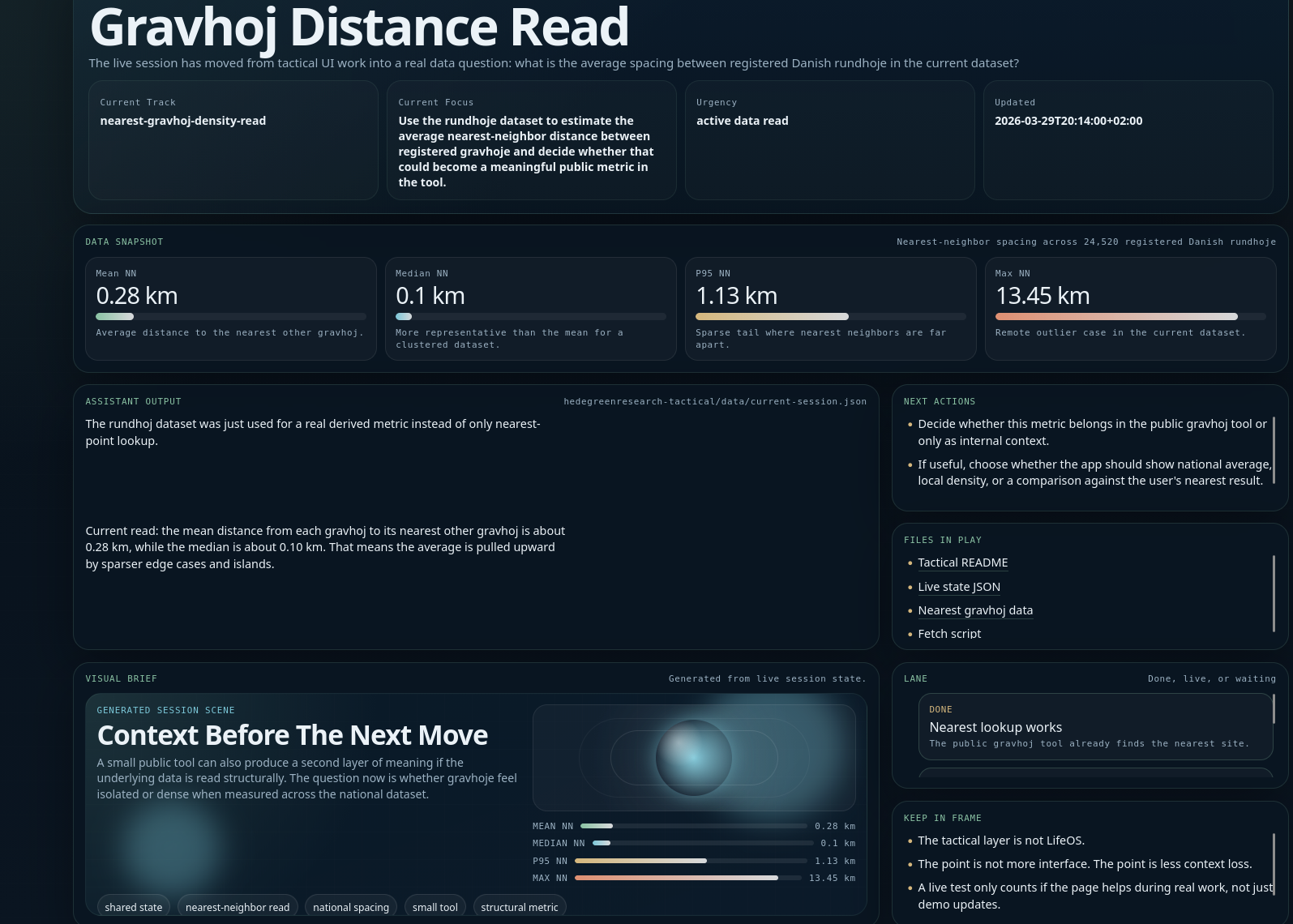
The gravhoj read matters for exactly that reason.
It breaks the atmosphere and forces the article back to reality.
At one point the work stopped being about the interface itself and became a concrete data question: what is the average spacing between registered Danish burial mounds in the current dataset?
The answer was not abstract.
The mean nearest-neighbor distance came out to about 0.28 km. The median was about 0.10 km. The 95th percentile was about 1.13 km. The max was about 13.45 km.
That is not a world-historic result.
That is exactly why it matters.
It proves the room was capable of producing something outside its own description.
That is the standard I care about.
If a workflow cannot produce trace, it does not matter how futuristic it feels.
This one produced trace.
That is why I am willing to say something stronger than “the tool was helpful.”
What changed tonight was not just that I had a shell and an assistant open at the same time.
What changed was that the machine could help hold the problem until the command became clear.
The old terminal assumed you already knew what to do.
This one could help keep the work intact while you figured it out.
That is enough to change how the work holds together.
But only if the language stays cold.
I do not mean friendship. I do not mean consciousness. I do not mean that a prompt window has become human.
I mean something narrower and more useful.
It could remember. It could resist. It could preserve context. It could keep state visible outside the conversation itself.
That is enough to change the feel of the work.
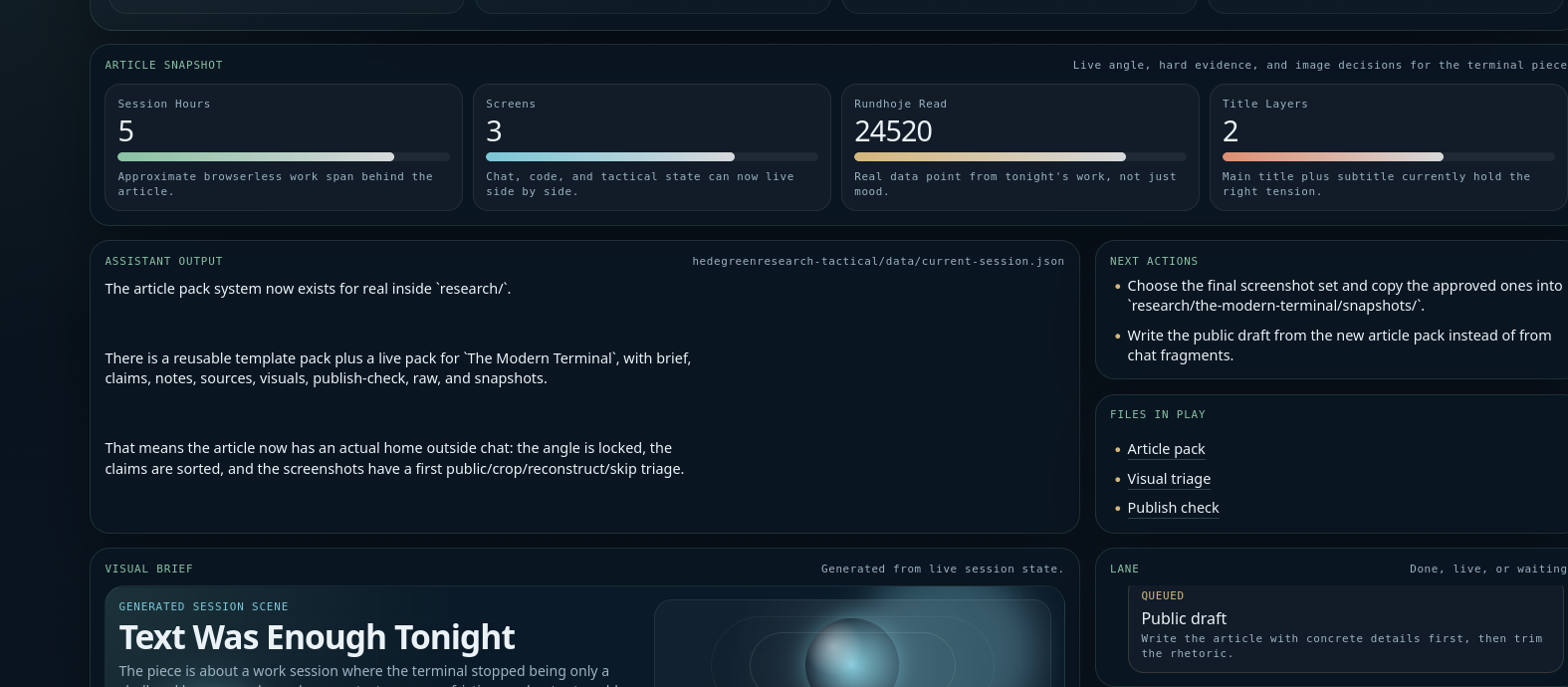
That is also why the second monitor matters.
The strange thing about tonight is that it was both more minimal and more distributed than older workflows.
The main working surface was still text. But the state did not have to remain trapped inside the chat window.
Code on one screen.
Conversation on another.
Shared tactical state on a third.
Not more interface for its own sake. Less context loss.
That is a different design goal.
And I think it matters more than most of the visual AI demos currently getting attention.
Because browser-based work has a built-in weakness.
The browser is powerful. It is also where fragmentation lives.
Tabs multiply half-decisions. A source becomes a detour. A detour becomes six tabs. Six tabs become a new mood. And the work that felt hot ten minutes ago is now distributed across temporary rooms.
The browser often gives the feeling of activity before it gives the fact of progress.
Tonight there was almost nowhere to hide.
Either a sentence moved the work forward or it did not. Either the file changed or it did not. Either the state stayed coherent or it broke.
That is harsh.
It is also clarifying.
I am not saying everyone should work this way.
I still need the browser. I still need public sources. I still need maps, uploads, reading, citations, and the rest of the ordinary web.
So this is not a manifesto against the browser.
It is something narrower.
For a certain kind of research-and-build work, a text-first room may now be the fastest path between a thought and something real.
Not because text is magical. Not because AI makes everything easy. Not because the machine can be trusted as proof.
But because memory, resistance, and continuity can now exist inside the interface itself.
That is enough to matter.
Earlier today I was walking in a forest. Tonight I was inside another kind of one.
Branches.
Paths.
Signals.
Openings.
Dead ends.
The difference is that this one talked back.
That sentence is more cyberpunk than I usually like. But I think it survives if I keep the rest of this honest.
Because the truth is not that I saw the future.
The truth is smaller.
I sat in text for five hours and got real work done.
And for the first time in my life, that felt less like a limitation than a choice.
— Dennis Hedegreen, trying to see the structure