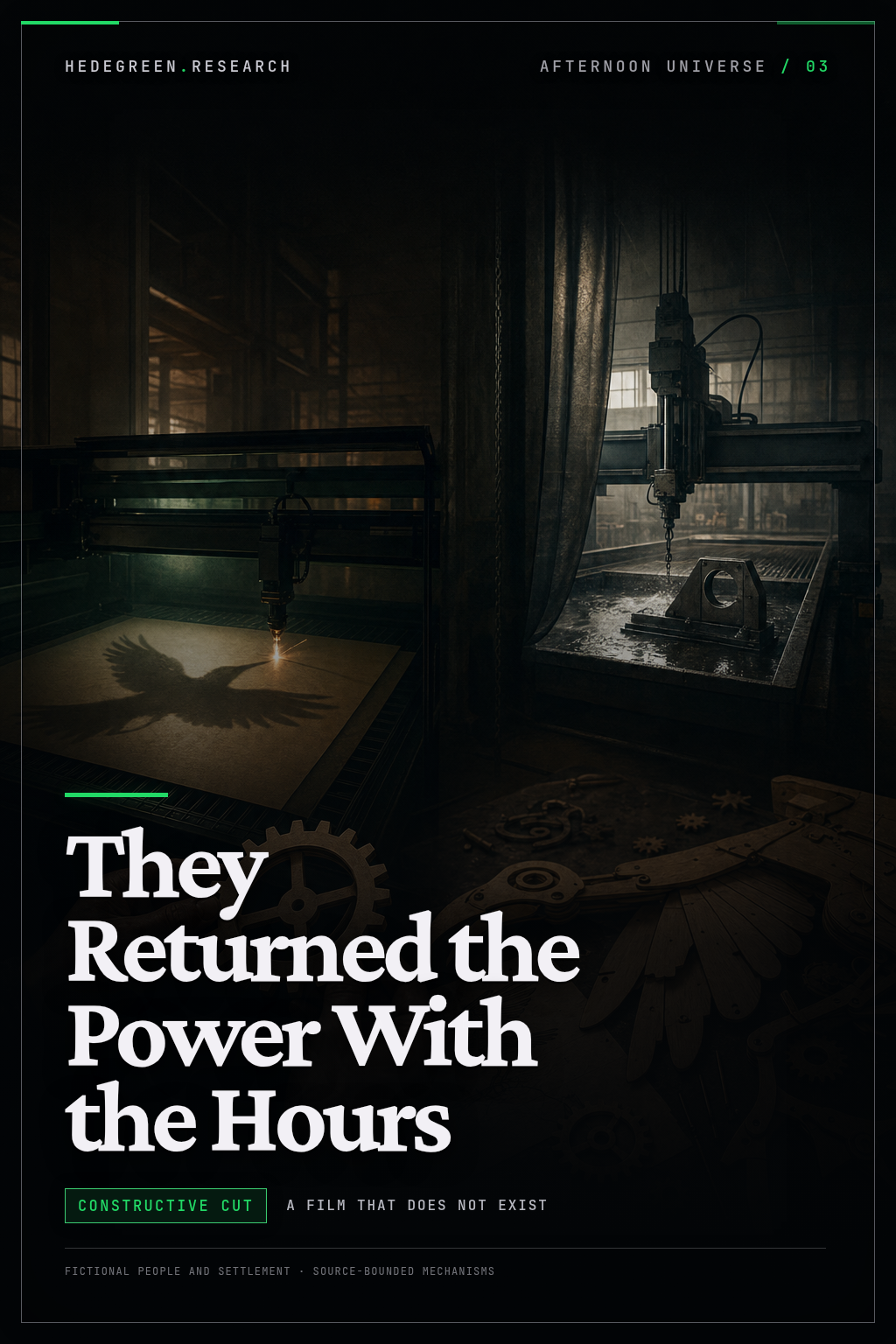
A controlled fictional future about returned time and publicly defended continuity.
Afternoon UniversePart III of III
Narrative method · Controlled fictional future. This story places documented mechanisms inside institutions and events that do not exist. It is not a forecast. Why Composite Stories?
The Machine That Stayed On
At 14:17, the same amber notice appeared above two unfinished jobs.
In the public machine hall, it arrived on the display beside the laser cutter.
The laser head did not slow.
It moved across a sheet of birch plywood, tracing the final wooden gear for a mechanical bird. The other pieces lay in a shallow box beneath the workbench: two wings, a narrow body and the small linkage that would make the beak open when the handle turned.
The bird belonged to a neighbourhood shadow-theatre group. It would appear for less than a minute in a performance at the end of the month.
At the next station, another user closed the lid of a small milling machine and pressed start.
The button changed to:
Nothing else happened.
Two streets away, the amber notice appeared above a waterjet cutter.
The machine was cutting ventilation brackets for an office renovation. It finished the line already in progress, lifted its cutting head and left the next sheet untouched.
Its display showed a different rule.
The shop had accepted that rule when it selected the flexible agreement. The monthly credit was real. So was the order on the production board.
The courier collection closed at 16:25.
The scheduling system moved the remaining brackets to the next morning. A green compliance mark appeared beside a red late marker.
The operator opened the event record. The current event remained fixed. Any dispute would be reviewed for later windows.
Back in the public hall, the queued user left the milling lid closed and began measuring the piece again.
The laser continued through the constrained hour. It cut the final tooth, returned to its resting position and released the lid.
The wooden gear was still warm when the workshop user lifted it from the tray. It fitted between the wings on the first attempt.
Across the district, one finished bracket remained on the wet cutting table. The next sheet had not moved.
The lights stayed on in both buildings.
No safety system had failed. No contract had been broken. No appeal had been ignored.
The mechanical bird opened its beak.
The order became tomorrow's work.
The Years of Empty Freedom
The hours arrived before the buildings did.
Automation had shortened scheduled work across transport, manufacturing, administration and maintenance. That achievement was real. Employers could no longer claim most of the week merely because full-time availability had once been normal.
The returned hours appeared on public calendars and annual accounts. People could see how much compulsory labour had retreated.
They could also see what had not moved with it.
The physical system still carried the shape of the old working day. Workshops opened for limited sessions. Public compute filled early. Cooling rooms expanded during dangerous heat and contracted when the emergency designation ended. Transport could bring people home from work more reliably than it could carry tools, children and care responsibilities across an open afternoon.
Home was not an empty unit of leisure either.
Meals still had to be prepared. Laundry moved around care visits. Cooling, charging and household coordination consumed time and capacity whether anyone called them work or not.
The first defence of the old arrangement was strong. Hospitals, water, communication, cooling and freight could not wait for a new philosophy of freedom. Capacity was finite. Building public rooms and maintaining equipment also required labour, money and electricity.
Nobody had proved that every returned hour needed a powered project.
But the absence of such proof had become a planning rule. Time counted as returned even when the practical ability to use it still depended on private space, private equipment or another purchase.
The society had counted the hours.
It had not yet decided what practical claim should travel with them.
The Capability Settlement
The Capability Settlement does not exist.
Neither the civic workshop floor, the public queue nor the commercial flexible-capacity agreement describes a current programme. They are fictional institutions assembled from mechanisms that exist separately across different jurisdictions.
European Union electricity law provides universal-service protections, recognises that vulnerability may include critical dependence on powered medical equipment and requires access to independent dispute mechanisms. In Great Britain, Ofgem's Priority Services Register offers additional support for disability, medical dependence and other vulnerable circumstances. Neither system creates a guaranteed quantity of electricity for ordinary civic activity.
Public technical access exists too. Helsinki Central Library's Urban Workshop offers reservable equipment including laser cutters, electronics workstations and 3D printers, with equipment use free and materials charged separately. Japan's Climate Change Adaptation Act allows municipalities to designate cooling shelters with stated opening times and expected capacity. These are public facilities with rules and limits, not evidence of electrical priority.
Commercial flexibility also has present analogues. The US Department of Energy describes voluntary demand reduction in return for discounts, credits or other remuneration. A separate large-load brief identifies cost allocation, reliability and risk sharing as live design questions. Neither source shows power being taken from a fabrication shop and given to a public workshop.
The fictional settlement combines these separate pieces. It protects a limited household and civic floor, publishes queue and priority rules, pays contracted flexible loads and permits later challenges to classifications. Private agreements remain. They no longer define every starting claim.
A public floor is not unlimited supply. An appeal is not additional electricity. A visible priority rule still leaves a real cost somewhere.
The defence is that ordinary activity receives a claim before purchasing power begins to sort the hour.
The objection is that officials still define the categories. Useful production can wait. Queues can favour organised groups. A transparent mistake remains a mistake.
The settlement does not tell the model which activity is morally superior.
It tells the model which constraints the optimiser may not erase.
The Model Was Asked a Different Question
The model did not choose the workshop.
That distinction mattered.
It forecast cooling, care, domestic work, mobility, public compute, commercial production and storage. It could move flexible demand, test network limits and calculate different continuity rules.
The civic floor entered somewhere else.
The institutions around the model supplied it as an explicit constraint beside hospital continuity, water systems, safety margins and contracted operating limits.
During the annual review, a critic called the floor a hidden subsidy.
The modeller opened two runs of the constrained afternoon.
In the first, the public floor remained. The laser continued, another public start queued and the commercial waterjet reduced to its contracted limit. The report retained both the capacity credit and the order delay.
In the second, the civic constraint was removed. The workshop paused, the public queue grew, some commercial reduction was avoided and the hour cost less.
The runs did not trace electricity from one site to another. They compared two sets of rules applied to the same physical system.
“Then the preference is political,” the critic said.
“Yes,” the modeller replied. “The model is showing its consequences.”
Nothing was hidden. The public floor appeared as a choice that benefited some activities, burdened others and used capacity that could have served a different claim.
The model could measure those effects.
It could not decide whether purchasing power should have been the only claim present before the calculation began.
The model did not discover a right.
It calculated the consequences of one.
The allocation was not neutral.
Its advantage was that it could not present itself as neutral.
Freedom With a Queue
The floor changed who could begin.
It did not remove waiting.
One apartment block had no shared battery. During a constrained evening, the household floor kept refrigeration, communication and one cooled room inside the protected limit. A carer could prepare food and finish the laundry without purchasing another service.
At the library, a public compute session continued long enough to complete a small language model for a local archive. No premium account was required.
These were not spectacular freedoms.
That was part of their purpose.
Elsewhere, the floor was smaller. A cooling facility reached its published capacity before the hottest hour. The next building had no public compute. Workshop reservations filled days in advance. A protected category could survive a constrained window and still be unavailable to the person who arrived after the queue closed.
The categories also made mistakes.
An independent repairer used a commercial registration because paid repairs covered the rent. Two evenings each week, the same benches were used for free lessons. The system saw one account, one workshop and one commercial load.
During a constrained evening, the free lesson was not recognised as civic use. It received no workshop-floor protection and waited in the ordinary queue.
The repairer requested a classification review. The review later recognised the mixed use and changed the next month's allocation. It could not return the missed lesson.
The fabrication shop received its capacity credit. The ventilation brackets still missed the courier. The customer moved the installation, and the shop moved another order to make room.
None of those costs proved that the civic floor was wrong.
They proved that it was an allocation.
A market-only system might have responded more quickly to some demands. A better-funded user might have paid for continuity. A rule set without the civic floor might have required less commercial reduction.
The settlement chose not to begin every constrained hour from that position.
It did not equalise outcomes.
It changed the claim from which people entered the constraint.
Every Priority Was Visible
At midnight, the settlement published its de-identified daily report.
Essential services had remained stable. The household floor had protected refrigeration, communication and cooling. The public workshop had completed one session and queued another. The cooling facility had reached capacity.
The commercial register showed reductions, credits and reported delays. The fabrication shop's ventilation brackets appeared on that list.
So did the classification ledger.
One mixed-use workshop had waited without civic-floor protection. The review changed its classification the following month. The missed lesson remained missed. Other claims were deferred or rejected.
The report did not conceal the allocation.
It recorded a bounded public claim and paid contracted flexibility. It also recorded waiting, unequal local capacity and costs that compensation had not repaired.
Its strongest critics did not need to allege a hidden machine decision.
They could point to the visible one.
Officials had decided which activities received a floor. Organised groups could shape those categories. Transparency did not make each priority fair. Private production did not become illegitimate because a public claim came first. Additional capacity could widen the floor. It could not decide what freedom required. Physical scarcity still limited the settlement.
At the end of the month, the workshop user turned the handle behind the shadow-theatre screen. The mechanical bird crossed the light. Its beak opened for less than a minute.
The delayed brackets had already been installed.
Neither fact settled the argument.
The report did something smaller.
It showed who had waited, who had been paid and which claim the system had protected.
The hours had come back.
This time, some power came with them.
— Dennis Hedegreen, trying to see the structure