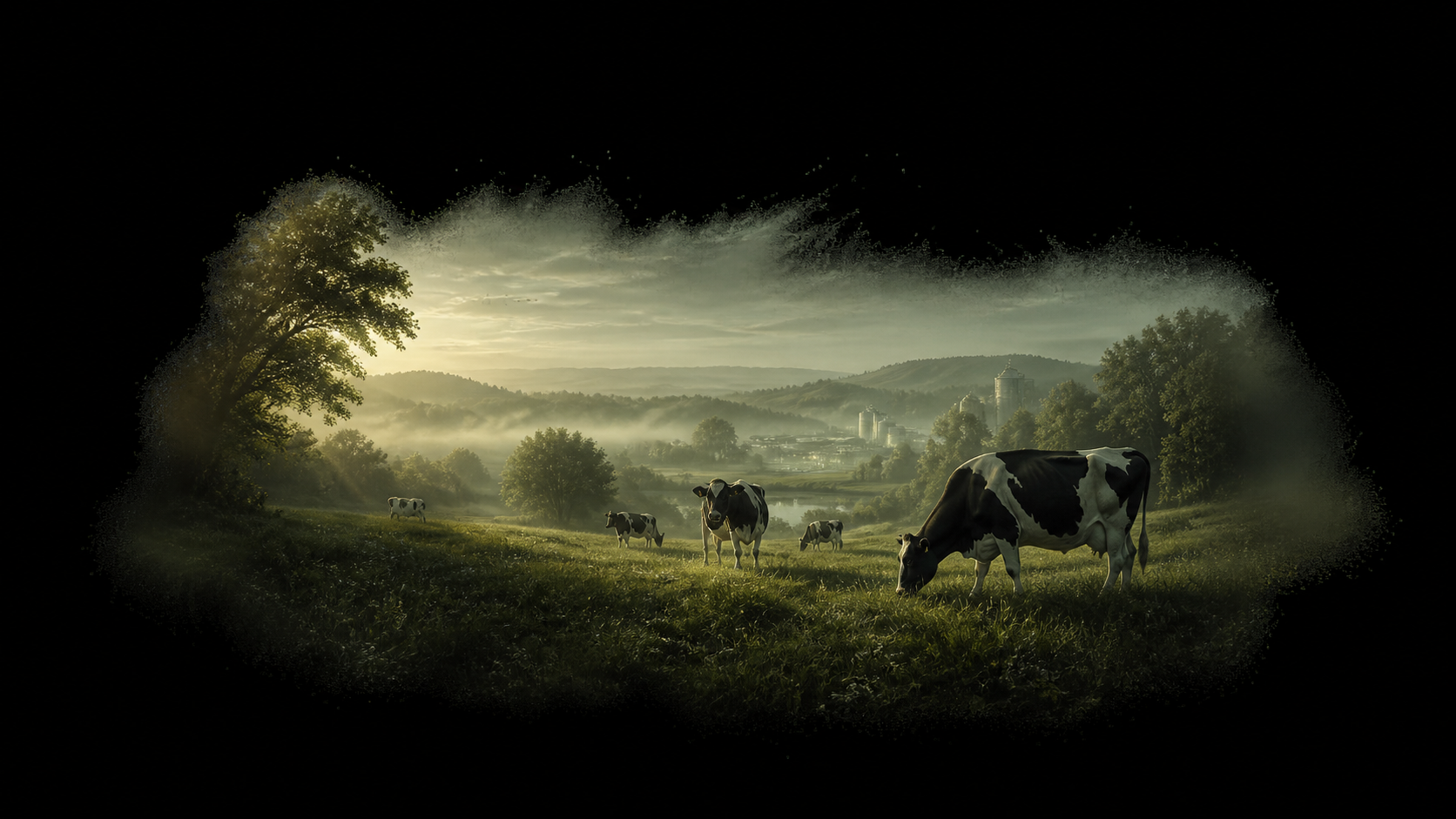
So I begin with respect.
How a small block under a hoof reveals the hidden engineering of modern dairy farming.
But respect does not mean looking away from the system built around her.
It means looking more closely.
The first time you hear it, it sounds like a joke.
Cows wearing shoes.
Not horseshoes. Not tiny metal arcs nailed under the hoof. Not something from a children's book.
But in modern cattle care, there really is such a thing: hoof blocks, claw blocks, orthopedic blocks, sometimes informally described as cow shoes. They are usually small pieces of wood, rubber, foam, plastic, or synthetic material attached to the healthy claw in order to lift weight away from an injured one. [1][8]
It sounds like a detail.
It is not.
Because once you understand the cow shoe, you begin to see an entire dairy system from the ground up: animal welfare, concrete floors, body weight, lameness, treatment timing, labor, milk yield, culling risk, farm management, and the quiet engineering required to keep a living production animal mobile.
Sometimes the best way to understand an industry is not to look at the factory.
It is to look at the foot.
The cow as a weight-bearing system
A dairy cow is not just an animal in a barn. She is a heavy biological system moving through a technical environment.
She must stand, walk, feed, drink, lie down, rise again, enter the milking system, and repeat the cycle every day.
That makes claws central.
Lameness is widely recognized as one of the major welfare and production problems in dairy cattle. A 2015 randomized clinical trial in Journal of Dairy Science called lameness one of the most significant endemic disease problems facing the dairy industry, with claw horn lesions such as sole hemorrhage, sole ulcer, and white line disease among the common conditions involved. [2]
Lameness is not just visible discomfort. It changes how the cow moves, how she distributes weight, and how well she fits into the production system. Studies have linked clinical lameness with reduced milk production; one UK study estimated an average 305-day lactation loss of about 360 kg of milk in clinically lame cows. [3]
So when a cow gets a "shoe", the object is not decorative.
It is an intervention in mobility.
What a hoof block actually does
The principle is simple enough to understand.
A bovine hoof has two claws. If one claw is injured, a block can be attached to the healthy partner claw. That raises the diseased claw away from the ground and reduces weight-bearing on the injured area. [4]
It is not magic.
It is load transfer.
A 2021 Journal of Dairy Science study described claw block application as a common pain-relief method in cattle with foot diseases and found that wooden claw blocks improved locomotion and weight-bearing characteristics. [5]
A 2023 study from Western Thailand also found that claw blocks promoted the healing capacity of claw lesions after claw trimming in lame cows. [6]
This is where the strange object becomes serious.
The cow shoe is a small piece of applied biomechanics.
The small object and the large system
There are objects that look too minor to matter until they reveal the system around them.
A hoof block tells us that dairy farming is not only about feed, genetics, milking robots, processing plants, protein markets, or export.
It is also about the floor.
How hard it is.
How wet it is.
How long the cow stands on it.
How quickly a limp is detected.
Who trims the claw.
Whether pain relief is used.
How early treatment begins.
How long a lesion is allowed to develop before someone intervenes.
The 2015 trial on claw horn lesions did not treat recovery as one simple thing. It evaluated treatment protocols involving therapeutic trimming, hoof blocks, and pain relief. [2]
That matters, because the hoof block is not a miracle tool. It is part of a treatment system.
And timing matters.
A 2016 randomized controlled trial on chronically lame dairy cows found that recovery after treatment was difficult once lameness had lasted more than two weeks; response rates were low across the treatment groups. [7]
That may be the uncomfortable lesson hidden inside the cow shoe:
By the time the block is needed, the system is already responding to damage.
Not a gimmick
It would be easy to write this as a cute agricultural curiosity.
"Look, cows have shoes."
But that would miss the point.
The hoof block is interesting precisely because it is ordinary. It belongs to the practical maintenance world of dairy farming. It is sold as farm equipment. It is used by hoof trimmers, veterinarians, and farmers dealing with real lesions in real herds. It is not a futuristic device. It is not a branding story. It is not artificial intelligence.
It is a block.
And that is why it is useful.
The block exposes the fact that modern dairy farming is full of small, physical, unglamorous systems that keep the visible system running.
Milk does not begin in the carton.
It begins in an animal.
And that animal stands on claws.
International problem, local feet
The cow shoe also travels well as a global dairy story.
A housed herd, a pasture-based herd, a small family farm, and a modern dairy unit may operate under different systems. But they all face the same basic physical truth:
A cow is heavy.
Claw disease hurts.
Lameness changes behavior.
Mobility affects welfare.
A cow that cannot walk properly becomes a problem for every dairy system.
That is why a small hoof block can become internationally relevant.
A 2023 New Zealand study did not ask whether hoof blocks were visually interesting. It asked how long different orthopedic hoof blocks persisted in lame cattle kept permanently at pasture. [8]
That is the kind of practical question that defines real agriculture.
A tool does not only have to make sense in theory.
It has to stay attached.
Under weight.
In motion.
In mud, moisture, pressure, and daily use.
On a living animal.
Seeing dairy from below
Dairy is often described from above: markets, exports, processing, climate, technology, nutrition, consolidation.
But the cow shoe forces another perspective.
From below.
From the point where the whole system meets the ground.
That small block under the hoof says something simple and brutal:
If the cow cannot walk, the system does not work.
It does not matter how advanced the milking robot is.
It does not matter how efficient the processing plant is.
It does not matter how optimized the feed plan is.
A dairy system still depends on a large animal being able to stand, walk, and bear weight.
That is why the cow shoe is more than an agricultural oddity.
It is a reminder that modern food systems are not purely digital, logistical, or industrial.
They are also anatomical.
They rest on bodies.
And sometimes, to understand the industry, you do not start with the milk.
You start with the hoof.
— Dennis Hedegreen, trying to see the structure
References
- M. F. S. Pyman, "Comparison of bandaging and elevation of the claw for the treatment of foot lameness in dairy cows," Australian Veterinary Journal, 75(2), 132-135, 1997. DOI: 10.1111/j.1751-0813.1997.tb14173.x. PMID: 9066971.
- H. J. Thomas et al., "Evaluation of treatments for claw horn lesions in dairy cows in a randomized controlled trial," Journal of Dairy Science, 98(7), 4477-4486, 2015. DOI: 10.3168/jds.2014-8982.
- L. E. Green, V. J. Hedges, Y. H. Schukken, R. W. Blowey, and A. J. Packington, "The impact of clinical lameness on the milk yield of dairy cows," Journal of Dairy Science, 85(9), 2250-2256, 2002. DOI: 10.3168/jds.S0022-0302(02)74304-X.
- J. K. Shearer, P. J. Plummer, and J. A. Schleining, "Perspectives on the treatment of claw lesions in cattle," Veterinary Medicine: Research and Reports, 6, 273-292, 2015. DOI: 10.2147/VMRR.S62071.
- J. Pluess, A. Steiner, and M. Alsaaod, "Short communication: Claw block application improves locomotion and weight-bearing characteristics in cattle with foot diseases," Journal of Dairy Science, 104(2), 2302-2307, 2021. DOI: 10.3168/jds.2020-19135.
- P. Arunvipas, T. Setkit, J. Wongsanit, T. Rukkwamsuk, N. Homwong, and A. Sangmalee, "Effect of claw blocks on the healing duration and lesion severities of claw lesions in lame cows in Western Thailand," Veterinary World, 16(2), 258-263, 2023. DOI: 10.14202/vetworld.2023.258-263.
- H. J. Thomas et al., "Recovery of chronically lame dairy cows following treatment for claw horn lesions: a randomised controlled trial," Veterinary Record, 178(5), 116, 2016. DOI: 10.1136/vr.103394.
- K. R. Mueller, R. A. Laven, and L. J. Laven, "Persistence of orthopaedic hoof blocks for the treatment of lame cattle kept permanently at pasture," New Zealand Veterinary Journal, 71(5), 236-243, 2023. DOI: 10.1080/00480169.2023.2216658.