AGI, Ancient Egypt, and what happens after the pyramid
I am an atheist.
So this is not an argument for gods.
It is an argument about what humans build around powers they do not fully understand.
People keep calling AGI a god. Sometimes as fear. Sometimes as marketing. Sometimes as prophecy. Sometimes as a joke from people who know the joke is not entirely a joke.
A system that sees.
A system that writes.
A system that remembers.
A system that builds.
A system that judges.
A system that may become too large for ordinary human language.
So the old language returns.
Oracle.
Demon.
God.
Superintelligence.
Alien mind.
But maybe the question is not whether AI is becoming a god.
Maybe the better question is:
Which god do people expect it to become?
Because when humans call something godlike, they are not only describing power. They are describing dependency. They are describing a force they want to consult, fear, obey, bargain with, hide from, or place above ordinary judgement.
That is why Ancient Egypt is useful here.
Not because AI is Egyptian.
Not because the gods were "really algorithms."
Not because we need cheap mythology pasted over technology.
Ancient Egypt is useful because its gods were not only characters. They were functions. They were interfaces between humans and forces too large to touch directly: the sun, death, writing, measurement, kingship, memory, order, chaos.
A god was not only a belief.
A god was an operating layer.
I. The Pantheon Problem
AGI is often discussed as if it were one thing.
One intelligence.
One threshold.
One arrival.
One god.
That is already the wrong frame.
Humans are not preparing to use AI like one god. They are preparing to use it like a pantheon.
They want Ra: the power to see from above.
But vision is only the beginning.
The real power begins when sight becomes writing, record, execution and judgement.
They want Thoth: the power to write, interpret, calculate, and explain.
They want Seshat: the power to record, index, measure, and preserve.
They want Ptah: the power to build, execute, and turn intention into form.
They want Ma'at: the power to judge rightly, align the world, and separate order from chaos.
And somewhere in the background, they need Khaemwaset: the one who walks among old monuments and notices that even empire forgets unless someone maintains the record.
This is not theology.
It is a functional map.
See for me.
Write for me.
Remember for me.
Build for me.
Judge for me.
That is not one god.
That is a civilization outsourcing its pantheon.
II. Thoth: The Writing Machine
Thoth is the first god most users meet.
Not as a statue.
Not as a temple figure.
As a text box.
Writing.
Calculation.
Language.
Interpretation.
The administrative layer between thought and record.
This is where large language models feel most familiar.
They take fragments and produce sentences.
They take documents and produce summaries.
They take uncertainty and produce form.
They take silence and produce something that looks like answer.
That is powerful.
It is also dangerous, because language has a seduction problem.
A well-formed sentence can look like understanding before understanding has happened.
A clean summary can hide the mess it was built from.
A confident paragraph can make weak evidence feel organized.
A fluent answer can create the impression that judgement has already taken place.
This is the Thoth-layer of AI: the system that writes faster than institutions can think, explains faster than users can verify, and produces confidence before judgement has caught up.
The future will not only be shaped by who has the largest model.
It will be shaped by who has the most trusted scribe.
And the scribe is never neutral.
The scribe decides what becomes legible.
What gets shortened.
What gets named.
What gets filed.
What gets forgotten in the conversion from world to text.
When a civilization begins to rely on a machine to write its emails, reports, lesson plans, legal drafts, medical summaries, internal memos, public statements and private reflections, the question is no longer only whether the machine can produce language.
The question is what kind of civilization begins to form around automated fluency.
III. Seshat: The Archive Behind the Voice
The chatbot gets the attention because it speaks.
But the archive is where power matures.
Seshat is the quieter figure.
Writing.
Measurement.
Record.
Books.
The institutional memory of the system.
That is the layer modern AI companies will want more than applause.
Not just users.
Memory.
Not just prompts.
Records.
Not just answers.
Context.
A personal AI that remembers your work, your fears, your unfinished thoughts, your relationships, your projects, your contradictions, your private drafts, your repeated questions - that is not merely a tool.
It becomes a memory institution.
And once memory is institutional, the question changes.
Not: "Can the system answer?"
But:
Who keeps the record?
Not: "Is the model smart?"
But:
What does it remember, what does it forget, and who can correct the archive?
Seshat is the part of AI that does not feel magical until you lose access.
Then you discover that the assistant was not just helping you think.
It was holding the continuity of your thought.
That is a different kind of dependency.
Search engines indexed the public web.
AI memory can index the private becoming of a person.
The unfinished idea.
The draft that never became public.
The repeated anxiety.
The plan abandoned three times and revived on the fourth.
The relationship between one thought and another.
That is no longer only data.
It is continuity.
And continuity is power.
IV. Ptah: When Speech Becomes World
Ptah is where the article becomes uncomfortable.
The Shabaka Stone preserves a theology of creation where Ptah is associated with thought and speech - heart and tongue. Interior formation and spoken command. The world made through articulation.
Stone Reader 01 · Shabaka Stone · heart/tongue · speech-as-creation · ⧉
That is not a perfect analogy for AI.
It is better than perfect.
Because the dangerous bridge in AI is not text generation.
The dangerous bridge is when text becomes execution.
Write the code.
Send the email.
Book the meeting.
Move the money.
Generate the report.
File the form.
Negotiate the contract.
Deploy the agent.
Act.
The chatbot was Thoth.
The agent is Ptah.
Thought becomes language.
Language becomes instruction.
Instruction becomes action.
Action becomes world.
An agent does not need to be conscious to become operationally powerful.
It only needs to sit between intention and execution.
Once that happens, the real question is not whether the system has a soul.
The question is who gave it permission to move.
V. Ma'at: Alignment Before Alignment
Every advanced AI conversation eventually becomes a judgement conversation.
Safety.
Alignment.
Fairness.
Bias.
Moderation.
Risk.
Truth.
Acceptable use.
Harm.
Modern language. Ancient problem.
Ma'at is not only "truth" in the small sense. It is order, rightness, balance, the world not falling into chaos.
In the Egyptian judgement scene, the heart is weighed. The person is not only remembered. The person is evaluated.
Stone Reader 02 · Book of the Dead 125 · heart weighing · judgement · ⧉
That is why Ma'at is the most dangerous AI parallel.
Because everyone wants aligned AI.
But aligned to what?
Aligned to law?
Which law?
Aligned to safety?
Whose safety?
Aligned to truth?
Whose institution gets to define the source?
Aligned to human values?
Which humans, under which economic system, speaking which language, seen by which model, funded by which company, deployed under which state?
Whoever defines Ma'at defines the judgement.
That line is the whole problem.
If AI becomes an administrative layer across schools, hospitals, job systems, courts, borders, insurance, welfare, war and markets, then "alignment" is not a technical checkbox.
It is the political theology of the machine.
The danger is not that the model judges.
Humans already judge through systems.
The danger is that the judgement layer becomes hidden behind a language of neutrality.
A risk score.
A safety category.
A policy violation.
A model refusal.
A recommendation.
A ranking.
A generated summary that becomes the version everyone reads.
Judgement does not need a courtroom to become real.
It only needs consequences.
VI. Khaemwaset: Even Empire Needed Maintenance
Then there is Khaemwaset.
Not a god.
More interesting than that.
A prince. A priest. A restorer. A figure later remembered through legend.
His importance here is not that he was "the first archaeologist." That phrase is too clean. Too modern. Too easy.
His importance is that he represents a civilization turning back toward its own past and recognizing that even monuments need maintenance.
Stone Reader 03 · Khaemwaset · Unas pyramid · restoration · ⧉
This is the moment where Ancient Egypt turns back on itself.
Even ancient Egypt had an ancient Egypt.
That sentence matters.
Because it means the past was already becoming distant while the civilization still existed. The monuments were not just eternal. They needed inspection, inscription, restoration, political reactivation.
Empire did not simply remember.
Empire maintained memory.
That is the Khaemwaset-layer of AI: not the model that speaks, but the system that maintains the record of what civilization thinks it knows.
This is where Hedegreen Research sits closest to the article.
The archive is not where memory rests.
The archive is where memory is maintained.
And maintenance is never neutral.
To restore is to choose.
To index is to choose.
To summarize is to choose.
To preserve is to choose.
To generate a PDF, attach metadata, write a source note, version a document, correct a line - all of it is memory work.
Civilizations do not only build monuments.
They build systems that decide what becomes a monument.
VII. If We Stopped Training Tomorrow
Ancient Egypt did not stop being a civilization because it built pyramids.
The pyramid was not the end of history. It was a phase: a visible concentration of labor, belief, administration, geometry, death, kingship and state capacity.
The world continued after the pyramid.
And more than that: the world inherited from it.
Not only stone.
Method.
Measurement.
Administration.
Architecture.
Calendar logic.
Records.
A way of making power visible through form.
The monument was not everything the civilization was. But it proved something about what the civilization could coordinate.
AI may be entering a similar danger.
Not because datacenters are pyramids in a simple metaphorical sense. That would be too easy.
But because scale has become the public proof of seriousness.
The largest model.
The largest cluster.
The largest training run.
The largest valuation.
The largest promise.
Power becomes visible as infrastructure.
Compute becomes stone.
Before the datacenter, there was a strawberry field.
I do not mean that literally in every case.
I mean the older human surface: soil, season, food, weather, labour, waiting, sweetness, decay.
Then the new monument arrives.
Concrete.
Cooling.
Power lines.
Security fences.
Compute.
A building where thought is industrialized without ever looking like thought from the outside.
The strawberry field is not more intelligent than the datacenter.
But it knows something the datacenter forgets:
Intelligence has to return to life, or it becomes only capacity.
Soil before compute.
Season before scale.
Sweetness before throughput.
The point is not nostalgia.
The point is use.
A strawberry has to return to a mouth.
A tool has to return to a life.
That is where the AI question becomes sharper.
Even if humanity stopped training new models tomorrow, we would already have built something extraordinary.
Not god.
Not AGI.
Not a finished mind.
A tool.
A strange, unstable, uneven, sometimes wrong, sometimes brilliant tool - but still a civilizational tool.
A system that can write, translate, code, summarize, teach, analyze, organize, generate, compare, search, simulate, explain and assist across languages, disciplines and social positions.
That is already enough to matter for centuries if we learn how to use it.
Maybe longer.
The tragedy would be to spend the next decade building higher and higher monuments while failing to teach ordinary people what can already be done with the stone we have cut.
The question is not whether AI development should freeze.
The question is whether progress can mean something other than more scale.
Can a teacher use it well?
Can a small shop survive platforms?
Can a citizen understand a legal document?
Can a patient prepare better questions?
Can a researcher without institutional backing build a method?
Can a father build structure around his life?
Can a local community use intelligence without surrendering memory to a private temple?
Maybe the model is not too small.
Maybe our method is.
VIII. After the Pyramid
After the pyramid comes the temple.
That is where scale becomes procedure.
Where access is controlled.
Where rituals are formalized.
Where priesthoods emerge.
Where ordinary people no longer touch the power directly, but approach through permission, interface, interpretation and fee.
This is the institutional future of AI if nothing interrupts it.
The model labs become oracles.
The cloud providers become temple walls.
The chip companies become quarry and stone.
The safety teams become doctrine.
The interface designers become ritual architects.
The governments become pharaohs seeking legitimacy from systems they cannot fully build themselves.
This future does not require AI to become conscious.
It only requires enough people to depend on it.
The god is never alone.
There is always a temple.
There is always access control.
There is always ritual.
There is always a class of people who explain what the system meant.
In the AI version, the priesthood may not wear robes.
It may write terms of service.
It may publish model cards.
It may define safety categories.
It may own compute.
It may approve APIs.
It may redact logs.
It may decide which language gets quality access.
It may decide who is too risky to serve.
It may decide which human intentions are permitted to become action.
You can reject gods and still build temples.
You can reject religion and still behave ritually around power.
You can say "it is only a tool" while reorganizing schools, states, work, war, memory and judgement around it.
That is why the Egyptian frame matters.
Not because it makes AI mystical.
Because it makes the social architecture visible.
The gods were never alone.
They came with temples, scribes, rituals, offerings, records, thresholds, permissions and interpretations.
The modern version will come with accounts, subscriptions, compute tiers, policy layers, safety filters, enterprise contracts, classified deployments, source logs, memory controls and API permissions.
Different costume.
Same human weakness.
But there is another phase possible after the pyramid.
Call it the village phase.
Not because it is small-minded.
Because it is where life actually happens.
The village phase asks a different question:
What can ordinary people do with the intelligence already released?
Not after AGI.
Not after the next model.
Not after the next trillion-dollar datacenter.
Now.
The village phase is not anti-scale. It does not deny that large systems will exist. It refuses to let scale become the only definition of progress.
The pyramid can stand.
The archive can remain open.
The tool can be used without being worshipped.
But only if the village is not reduced to a customer queue outside the temple.
IX. Stone Reader Note
This article uses Stone Reader markers for selected ancient Egyptian passages.
They are not decorative mythology.
They are not automatic translation.
They are source capsules: a way to show that ancient sign, transliteration, translation and modern interpretation are separate layers.
Translation is an interface, not the original.
That is part of the argument.
A god was an interface.
A translation is an interface.
A chatbot is an interface.
A PDF is an interface.
An archive is an interface.
A source note is an interface.
The question is always:
What stands between the human and the force?
And who controls that layer?
X. The Temple and the Village
This is not an article about Egyptian gods.
It is not even, mainly, an article about AGI.
It is an article about the human habit of building systems around power before fully understanding what the power is doing to us.
Ancient people were not stupid because they gave names to forces larger than themselves.
Modern people are not smart just because they stopped using those names.
We still name forces.
We call them markets.
We call them platforms.
We call them models.
We call them systems.
We call them alignment.
We call them intelligence.
We call them infrastructure.
Then we organize our lives around them.
The next decade of AI does not have to be only about making the machine larger.
It can also be about making humans more capable around the machine.
That is the real choice after the pyramid.
Not whether the monument exists.
It already does.
If there is a Hedegreen Research position here, it is this:
Do not worship the interface.
Learn to read the layer.
The choice is whether the archive remains correctable.
Whether the scribe is mistaken for the truth.
Whether the judgement layer can be challenged.
Whether ordinary people can use the tool without kneeling before the institution that controls it.
AGI is not a god.
But humans know how to build temples.
The choice is whether the temple captures the village.
Stone Reader
This is not an automatic translation system.
It is a curated reading layer.
The point is to show the interface between sign, source image, transliteration, translation, interpretation and article argument.
ancient sign -> source image -> transliteration -> translation -> interpretation -> article argument
Stone Reader 01 · Shabaka Stone

Theme: Ptah, heart and tongue, speech-as-creation.
Original layer: Source-object image. Not yet a verified crop of the exact heart/tongue line.
Transliteration: Not shown until a checked line is selected.
Translation: Curated, not automatic. The source support is that Ptah gives life through heart and tongue, and that divine speech comes through what the heart devises and what the tongue commands.
HR reading: Thought becomes speech. Speech becomes command. Command becomes created thing.
Boundary: This is an analogy about execution, not a claim that AI is Ptah or that the Shabaka Stone predicts AI.
Stone Reader 02 · Book of the Dead 125

Theme: Ma'at, judgement, right order.
Original layer: Visual witness to the judgement scene / Chapter 125 tradition. The UCL textual witness used for the transliteration anchor is different.
Transliteration: Possible UCL anchor: Ddt xft sprt r wsxt nt mAaty. Use only with context.
Translation: Curated, not automatic. Chapter 125 is associated with declarations of innocence and the judgement scene where the heart is weighed.
HR reading: Whoever defines Ma'at defines the judgement.
Boundary: Ma'at is not identical to modern AI alignment. The article uses it as a functional frame for order, rightness and judgement.
Stone Reader 03 · Khaemwaset / Unas
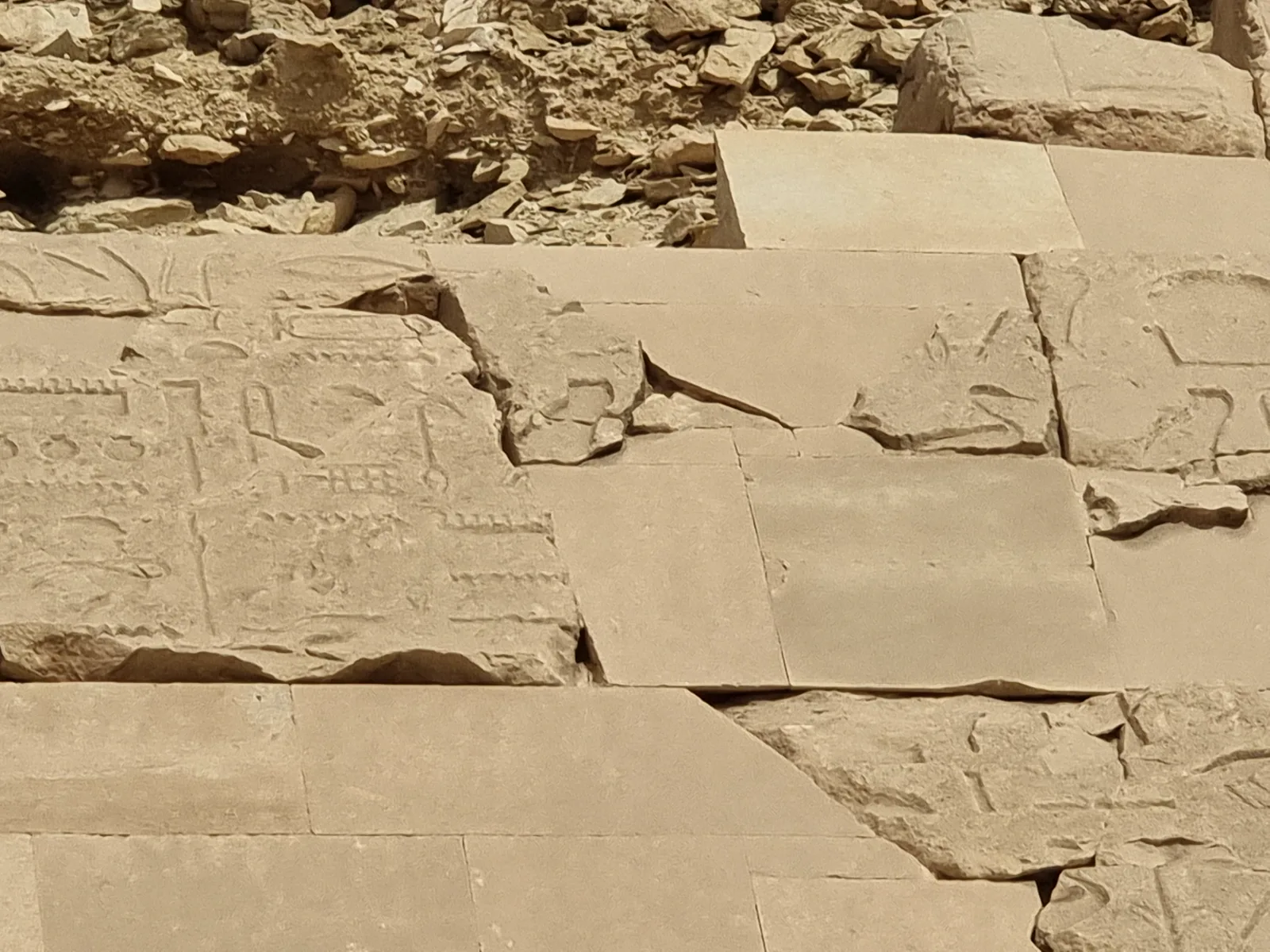
Theme: Memory maintenance, restoration, old monuments inside a still-living civilization.
Original layer: Source photograph of the restoration text.
Transliteration: Not shown until a checked line is selected.
Translation: Curated, not automatic. The supported reading is that Khaemwaset perpetuated the name of King Unas and is presented as desiring to restore royal monuments whose strength was falling into decay.
HR reading: Even ancient Egypt had an ancient Egypt.
Boundary: Avoid the clean modern label "first archaeologist" except as a label being resisted.