Apple once built an institution for futures that did not yet belong to a product. Then it cut that institution away to survive. The richest Apple in history still lives by the emergency discipline of its poorest years.
An old orchard does not preserve every tree because it produces the largest, brightest or easiest fruit to ship. Some trees remain because they carry something the commercial crop has lost: a flavour, resistance to disease, tolerance for an unusual winter, a different harvest time, or simply another possible way for an apple to be an apple.
Apple was once the tree at the edge.
It was opinionated, vertically integrated, difficult to compare with anything around it and frequently wrong. It was also willing to enter industries where it did not belong, remove interfaces people considered permanent and place successful products in danger of being replaced by the next one.
The modern company still carries much of the visible Apple phenotype. The products are integrated. The silicon is exceptional. The supply chain is disciplined. The ecosystem compounds. The cash arrives.
The question is not whether Apple can still make excellent Apple products. It is whether the institution still preserves the unusual traits required to make a product that threatens Apple.
This investigation began with three hypotheses.
The first two failed. The third remains open.
Hypothesis One: Apple stopped funding the future
Rejected.
Apple reported approximately $602 million in research and development expenditure in fiscal 1992. In fiscal 2025, it reported $34.55 billion.
Absolute spending alone tells us little because Apple is now a vastly larger company. The more revealing comparison is R&D as a share of revenue.
In fiscal 1992, Apple spent approximately 8.5 per cent of revenue on R&D. By fiscal 2012, the share had fallen to approximately 2.2 per cent. In fiscal 2025, it had climbed back to approximately 8.3 per cent.
By one narrow but important measure, Cook’s Apple has returned to the research intensity of 1992 Apple.
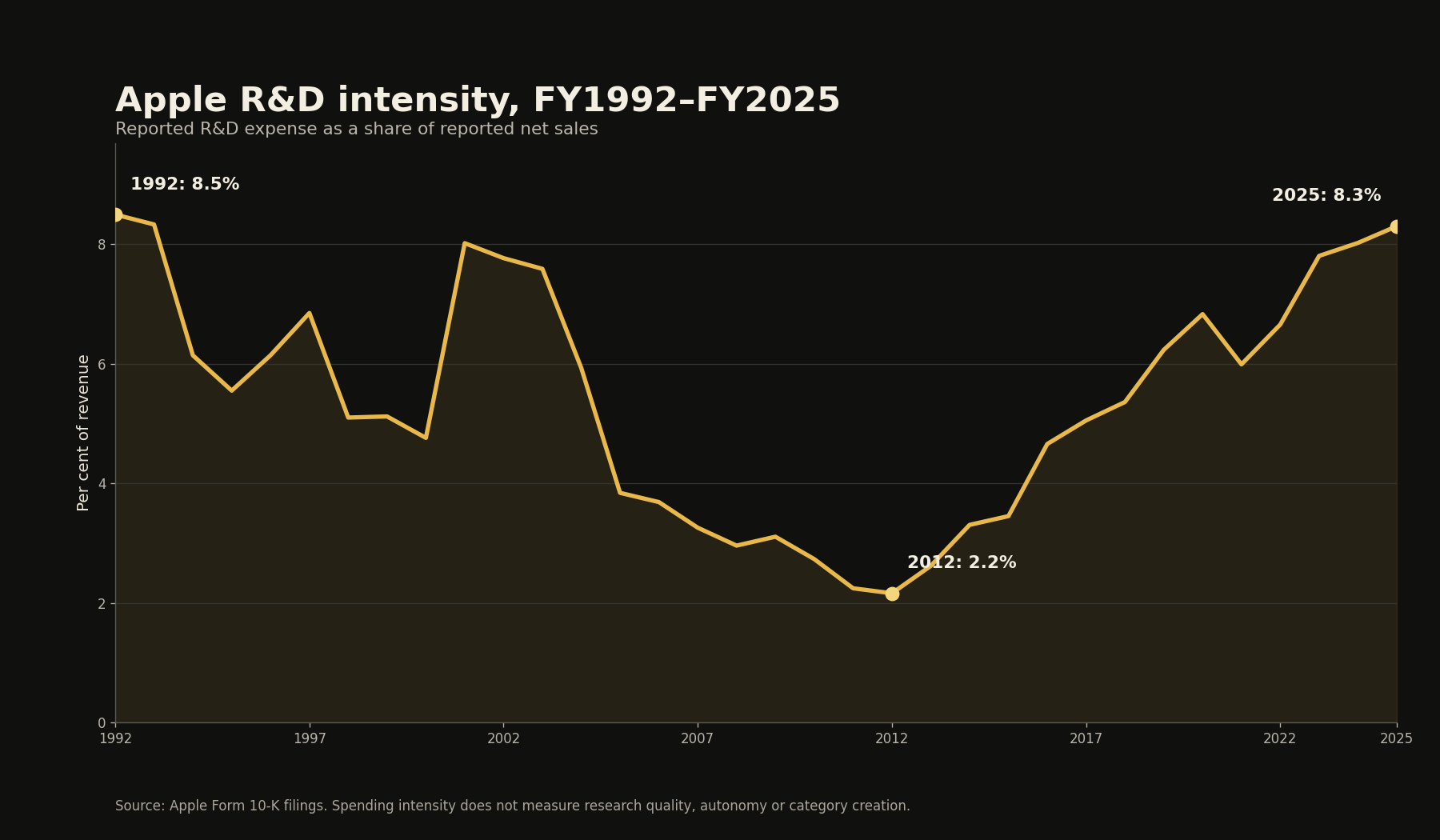
The simple accusation does not survive the filings. Apple has not starved research relative to its own size, and R&D intensity rose substantially during the Cook era.
This removes the easiest explanation. A research budget cannot tell us what the organisation permits that research to endanger. It cannot separate maintaining a global platform from replacing one, reveal how many projects survive internal review, or show whether deep research must converge toward an existing product group before it is allowed to become visible.
The question therefore moves from funding to permission:
What is Apple’s R&D organisation allowed to threaten?
Capital allocation still belongs in the picture. From fiscal 2013 through fiscal 2025, Apple used approximately $816 billion for common-stock repurchases, compared with approximately $233 billion in reported R&D expenditure.
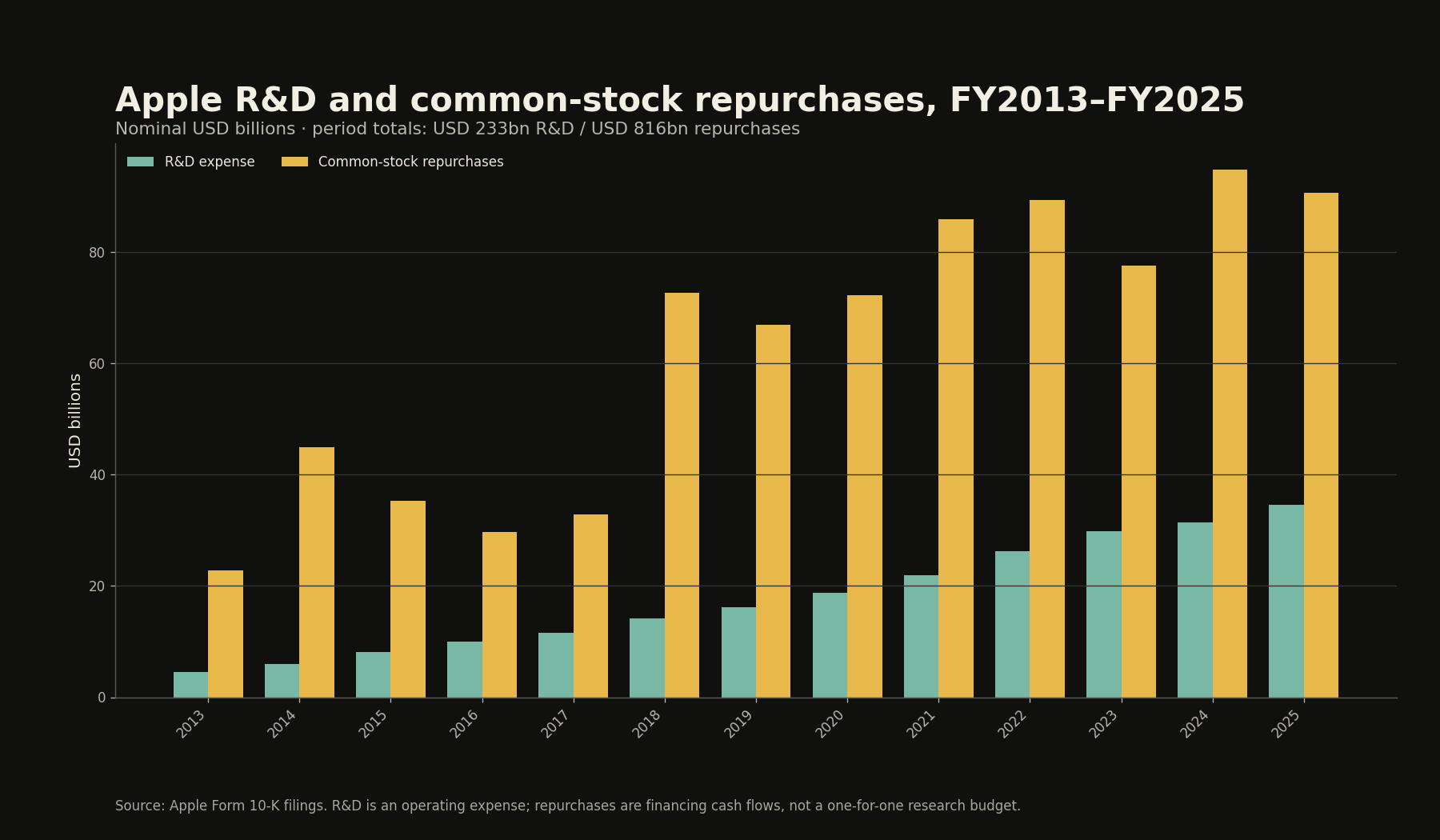
These are not interchangeable accounting categories. A dollar not used for a buyback cannot automatically become a useful research dollar. But the scale establishes that Apple can afford institutions whose work may remain commercially insignificant for ten, twenty or thirty years.
Money is not the binding constraint.
Hypothesis Two: Tim Cook’s Apple stopped taking large risks
Rejected.
Apple Watch was a genuine category bet. It required a new physical interface, custom silicon, a developer platform and the integration of health, communication and personal computing into an object worn continuously on the body.
Apple silicon is an even harder counterexample. Apple replaced the external processor architecture on which the Mac depended, rebuilt the hardware roadmap, created a developer transition system, supported multiple software architectures and moved an established computing platform across a technological fault line without destroying it.
That is not the behaviour of an institution incapable of risk.
Vision Pro required a new device architecture, a new operating system, a new interaction model and a new development surface. Project Titan appears to have consumed years of work before Apple cancelled it. Apple Intelligence reaches across the company’s principal devices and attempts to place models, private cloud infrastructure and personal context inside the operating system itself.
Modern Apple still takes enormous technical and organisational risks. The difference lies in what those risks become after they leave the laboratory.
Jobs-era Apple repeatedly converted unfamiliar technology into a new ordinary interface. iPod made digital music into a consumer object. iPhone made the networked pocket computer ordinary. iPad gave direct-touch computing a new physical scale.
Cook-era Apple has demonstrated exceptional ability in architecture, integration and infrastructure. Its record of converting those achievements into the next broadly adopted primary human-computer interface is less settled.
Watch became a durable category, but initially reinforced the iPhone. Apple silicon transformed the roots of the Mac without changing where most people encountered computing. Vision Pro is a genuine attempt at a new interface, but remains far from ordinary. The car never shipped. Apple Intelligence deepens the existing product system rather than creating a new object outside it.
Hypothesis Three: Apple weakened its conversion institution
Still open.
The live hypothesis is not that Apple lacks money, researchers or technical courage. It is that Apple weakened the institutional capacity that turns unfamiliar technology into a new ordinary human interface.
Apple may have become better at building the roots and less reliable at producing a new kind of fruit.
That claim has to survive Apple’s own history.
There Is No Bell in Apple
The sentence arrived before its definition. Taken literally, it is false.
Apple employs researchers, publishes fundamental machine-learning work, participates in major academic conferences, funds doctoral scholars, operates research residencies and conducts work across privacy, accessibility, vision, language, health, human-computer interaction and algorithms.
There is research in Apple. There are laboratories in Apple. There are long-horizon technical programmes inside Apple.
The institutional sentence is different:
There is no publicly legible Bell-shaped body inside Apple.
Bell Labs was not simply an unusually large R&D department. It joined immediate engineering problems from a working communications system, fundamental science whose commercial destination was not yet known, and a development organisation capable of carrying discoveries from laboratory work into functioning infrastructure.
Apple’s research is publicly visible in organs: machine learning, health, silicon, security and secret programmes attached to possible future devices. What is not visible is one institution responsible for holding the whole question.
No current Apple body publicly presents itself as responsible for asking what computing should become twenty or thirty years from now, before the question belongs to the iPhone group, the Watch group, the Vision group, the health organisation or the machine-learning organisation.
Apple has Bell-like organs. What is not publicly visible is a Bell-shaped body.
But that conclusion contains a historical mistake.
Apple once had one.
There Used to Be a Bell in Apple
In 1986, Apple established the Advanced Technology Group.
ATG existed to work beyond the immediate time horizon and organisational responsibility of ordinary product divisions. Its research crossed interfaces, speech, networks, education, collaboration, media, information access and forms of computing that did not yet possess a stable product category.
It was close to the institution this investigation initially assumed Apple had never built.
Knowledge Navigator emerged from the same intellectual environment, although it was not an ATG product roadmap. The film was funded through Apple’s Higher Education Marketing organisation, produced rapidly and assembled with contributions from designers, educators, marketers and advanced technologists. It was not a secret thirty-year plan for a device Apple already intended to manufacture.
It was a public rehearsal.
Apple did not know exactly how the future would work. It nevertheless felt obliged to make the future coherent enough to show. Knowledge Navigator brought files, research, communication, simulation, natural-language interaction, delegation and personal context into one understandable human workflow before the necessary web, mobile infrastructure, cloud systems and language models existed.
Modern Apple possesses far more technical capacity than the Apple that made that film. It exposes several future vectors—personal AI, spatial computing, continuous health measurement, privacy-preserving infrastructure, custom silicon, identity, payments, accessibility and ambient wearables—but no coherent public answer to:
What should all of this be for in 2056?
The orchard was cut down
ATG did not gradually disappear because Apple forgot it existed. Apple shut it down in 1997 during the restructuring that followed Steve Jobs’ return.
Larry Tesler, who had helped create the group, later described being asked to identify which ideas should be saved and which should be killed. His judgement was not romantic: closing ATG was the right decision. Much of what remained was technically interesting but too remote from what Apple could use or sell.
That changes the moral structure of this article.
The Bell was not lost under Cook. It was amputated under Jobs.
Apple in 1997 was reducing product lines, cutting programmes, ending licensing arrangements and attempting to survive. Jobs imposed brutal discipline: fewer products, clearer ownership, concentrated engineering and little tolerance for work without a credible place in the company’s recovery.
Newton went.
Pippin went.
The clone programme went.
ATG went.
The famous four-quadrant strategy was not heirloom conservation. It was emergency pruning, and it worked.
The Apple remembered for the iMac, iPod, iPhone and iPad was made possible partly by destroying the organisational diversity this article proposes restoring. Jobs did not save Apple by preserving every unusual branch. He cut the company back until a small structure could receive enough water, light and managerial attention to live.
The lesson cannot be that Apple should recreate the organisational sprawl of the mid-1990s. The lesson is more difficult:
A company close to death may have to remove every organ that does not keep it alive next year. A company with Apple’s present resources does not face the same biological constraint.
The poorest modern Apple survived by cutting down the orchard. The richest Apple never fully replanted it.
ATG also explains why Bell is not enough
A research institution is not valuable merely because it produces strange ideas. ATG also had a conversion problem.
Research could flourish without finding a reliable route into products. Important concepts and technologies emerged from the environment, but too much work remained disconnected from the organisational machinery responsible for manufacturing, distribution and mass adoption.
The laboratory and the product company were not always joined by a functioning bridge. This reveals the missing stage in the original model.
The chain is not:
Bell → Heirloom → Apple
It is:
Bell → Heirloom → Conversion → Cosmic Crisp → Apple
Bell holds fundamental and cross-disciplinary questions before anyone knows which product should own them.
Heirloom preserves unusual combinations of traits and places small experimental generations into the world.
Conversion identifies which human value is real, which compromises matter and which parts of the concept deserve to survive.
Cosmic Crisp is the deliberate breeding process: comfort, price, software, manufacturing, distribution, repair, cultural acceptance and repeatability.
Apple is the industrial form when the new object is ready to become ordinary.
The old Apple was extraordinary at conversion. It did not invent every component underlying the iPod, iPhone or iPad. It took immature technologies, incompatible systems and unresolved behaviours and refined them into objects that millions understood immediately.
That ability is not identical to research, design or manufacturing. It is the institutional craft of deciding which strange traits must survive the journey to scale.
The courage to learn in public
Apple still demonstrates the courage to invent in private. The harder question is whether it retains the courage to learn in public.
A company can spend a decade on a secret programme while avoiding the social vulnerability of releasing an early category. An internal prototype can remain promising indefinitely. A public product receives reviews, jokes, returns, developer indifference, low sales and uncomfortable evidence about how people actually behave.
The first iPhone was not complete. Its network was slow, its carrier arrangement restrictive, and it lacked the native third-party application platform that later became central to its value. But the central proposition was undeniable: direct manipulation of a networked pocket computer through multi-touch. Apple understood which part had to prove the category and which parts could mature through generations.
Vision Pro makes this distinction difficult. Technically, it is extraordinary. Apple solved problems in displays, tracking, sensing, latency, interaction, silicon and operating-system design while asking one device to serve as a research platform, public prototype, developer machine, luxury object, finished Apple product and beginning of the next computing era.
Mass adoption was never a reasonable immediate test. New computing categories can require several generations before price, weight, software, behaviour and social acceptance converge.
Apple has continued the programme. In October 2025, it released an upgraded Vision Pro with the M5 chip and a new Dual Knit Band while retaining the $3,499 starting price. The refresh improved performance, display rendering, battery life and comfort.
That matters: Apple did not treat the first device as a one-off. But a chip-and-comfort refresh is not yet the same as generational category learning. It improves the machine inside the existing proposition without materially changing its price, social form or everyday role.
Apple perfected the prototype. It has not yet demonstrated the adoption path.
The fair question is whether Apple has built a path through generation two, three, four and five while the category remains commercially small and socially awkward.
The missing public orchard
Apple has developer transition kits, research frameworks, health studies, security research devices, beta software and selected external collaborations. It does not have a permanent consumer-facing place where a strange product can be publicly early without being interpreted as a failed Apple product.
The current path appears to be:
Secret programme → internal perfection pressure → global Apple launch or cancellation.
The missing layer is generational public learning.
A separate institutional channel could release small numbers of narrow products without pretending that they represent their final commercial form. These projects could be expensive, incomplete outside one central proposition, intended for unusual users and commercially insignificant for several generations. Their purpose would not be to lower Apple’s quality standard, but to apply the correct standard to the correct stage.
An heirloom project needs one trait worth preserving. It does not need to be the finished global crop.
Most should remain small. Some should fail. A few might reveal a trait valuable enough to carry through conversion and industrial breeding.
That is the orchard Apple is missing: not a warehouse of abandoned prototypes, not innovation theatre, and not a corporate museum where ideas survive because nobody is responsible for killing them. A functioning orchard has pruning, selection, grafting, failure and harvest. It simply does not judge every young tree by the output of a mature commercial crop.
The graft that left
Jony Ive should not be treated as a magical individual whose brain can be priced from an acquisition headline. The more serious object is the portable group: people carrying shared judgement, methods of critique, manufacturing relationships, aesthetic instincts, knowledge of materials and tolerances, and the ability to recognise a product before the market has a name for it.
Two distinct legal disputes now sit around that graft.
In iyO’s trademark case, the startup challenged OpenAI and its partners over the use of the name io. OpenAI later told the court that it would not use io, iyO or similar branding for its AI hardware products.
Separately, Apple filed Apple Inc. v. Liu et al., case 5:26-cv-07078, in the U.S. District Court for the Northern District of California on 10 July 2026. The named defendants are Chang Liu, Tang Yew Tan, OpenAI Foundation, OpenAI Group PBC and io Products. Apple alleges misappropriation of trade secrets and confidential information in connection with OpenAI’s hardware effort.
As of 13 July 2026, those allegations have not been adjudicated. OpenAI says it has no interest in other companies’ trade secrets.
Apple’s own complaint says that more than 400 former Apple employees now work at OpenAI.
The graft, measured by the tree it was cut from.
Jony Ive is not named as a defendant. That distinction reinforces the boundary rather than weakening the argument. The lawsuit concerns documents, access, confidential materials and specific alleged conduct. It does not attempt to confiscate a former designer’s accumulated judgement.
Neither dispute proves that product culture was transferred unlawfully.
A company can protect documents, prototypes, supplier records and identifiable trade secrets. It cannot require former employees to forget years of accumulated judgement.
The legal cases concern what may have crossed that boundary unlawfully. This investigation concerns the lawful remainder:
What did OpenAI believe an intact group of former Apple product people could do that could not be recreated by hiring an equal number of unrelated engineers?
The answer may be product-conversion culture: not one legendary designer, but a group capable of turning technical possibility into a coherent human object.
The counter-case
A central Bell-like institution may be the wrong answer.
Distributed research can sit closer to real engineering problems. Product groups can integrate science more effectively than a distant corporate laboratory. A separate public experimental brand could create confusion, weaken accountability and protect projects that deserve to die.
ATG demonstrates those risks. It generated ideas but struggled with conversion. Apple survived by restoring product ownership and forcing technical work to serve fewer, clearer outcomes.
Apple silicon suggests the modern structure can produce extraordinary long-horizon results without a central Bell. Watch shows that Apple can still enter a new product category. Vision Pro shows that it remains willing to establish a new operating system and interaction model.
The absence of a public 2056 film may reflect discipline rather than a lack of imagination. Apple may prefer to show a future only when it can manufacture part of it. A protected long-horizon institution may also exist internally without a public name, charter or research identity.
This investigation can establish what Apple makes visible. It cannot prove the absence of what Apple keeps hidden.
But public coherence is not irrelevant. A company that shapes communication, health, identity, education, payment and personal agency does more than manufacture private products. Its devices become cultural and civic infrastructure. The question of what those systems are ultimately for should not remain entirely inside confidential product meetings.
Replanting after survival
Apple did not lose its Bell by accident. It removed it during an emergency, alongside products, programmes and ambitions the company could no longer afford to carry.
The surgery helped save Apple. It also turned emergency discipline into permanent corporate virtue: focus, secrecy, integration, clear ownership and intolerance for work without a path to a product.
That discipline produced extraordinary fruit. But an orchard cannot be governed only by the rules of harvest.
In 1997, Apple could not afford to preserve every strange branch. In 2026, it can afford to plant again.
The challenge is not to recreate ATG exactly as it existed. It is to solve the problem ATG never fully solved: build a Bell without rebuilding the bloat; create an Heirloom channel without protecting permanent laboratories of unfinished work; establish a conversion institution with authority across product boundaries; permit small public generations without turning the Apple name into a beta label; preserve unusual traits while remaining ruthless about which ones deserve to reach scale.
Apple still has the courage to invent in private. What it has not yet demonstrated is the courage to learn in public.
The poorest Apple survived by cutting down the orchard.
The richest Apple must decide whether it still knows how to grow one.
— Dennis Hedegreen, follow the data
Sources and method
This investigation began with three hypotheses. The financial record rejects the first; the product counter-cases reject the second; the institutional third remains open. A negative public-evidence finding is not proof that a confidential Apple institution does not exist.
- Apple FY1994 Form 10-K, FY2012 Form 10-K and FY2025 Form 10-K anchor the financial series.
- Larry Tesler's Computer History Museum oral history supports the ATG history and shutdown account. Hugh Dubberly's production history supplies the Knowledge Navigator institutional correction.
- Apple Machine Learning Research and Apple's October 2025 Vision Pro update support the current-research and counter-case passages.
- The official N.D. Cal. case page and the filed complaint support the legal passage. The allegations were unadjudicated as of 13 July 2026; the complaint's employee count is not evidence of wrongdoing.
- USDA's apple germplasm collection and Washington State University's WA 38 / Cosmic Crisp record bound the orchard and cultivar metaphor.
Financial series, calculations, direct SEC accession locators and the full source ledger are preserved in the local editorial workpack.