Fragmentation returned.
I could feel it happen.
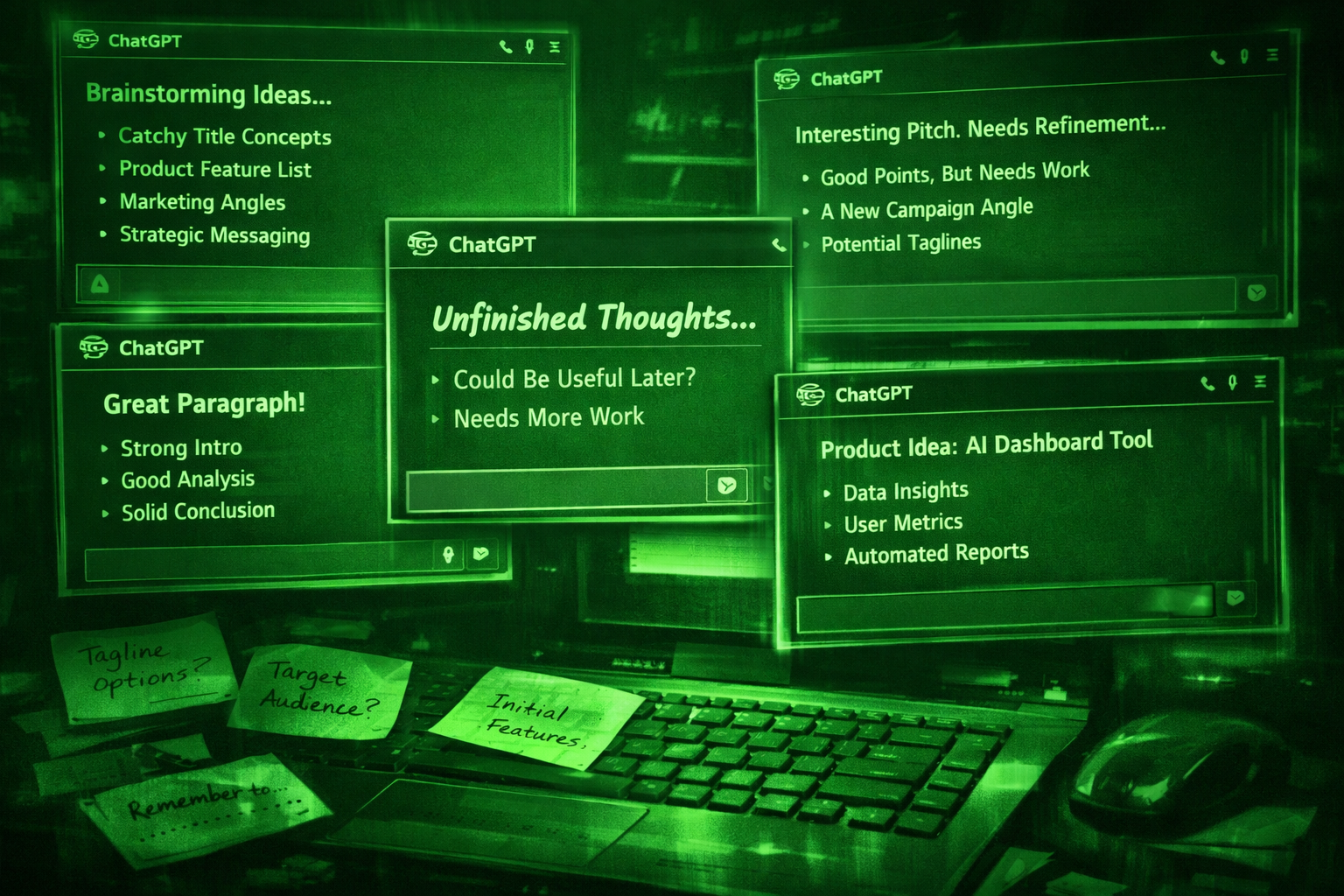
The token ceiling was getting close. The main loop was under pressure. So instead of staying inside the system I had built, I drifted back into the older pattern. I opened ChatGPT. Then another window. Then another.
I started generating again.
Ideas.
Angles.
Marketing language.
Useful things, maybe.
But they were being made in the wrong place.
That is the part that matters.
The problem is not that chat produces bad ideas.
Chat can produce very good ideas.
The problem is what happens when the work spreads across temporary rooms and never gets pulled out.
That is one of the older failure modes.
Not lack of thought.
Fragmentation.
A good title in one chat.
A strong paragraph in another.
A product idea in a third.
A useful framing in a fourth.
Enough intelligence to build something real.
Not enough continuity to keep it alive.
That is exactly what the newer system was supposed to solve.
LifeOS exists because thought is not enough. The publishing flow exists because drafts are not safe inside friction. The project structure exists because ideas that only live in chat are not really part of the work yet.
And still, under pressure, the old reflex comes back.
Open another window.
Start another thread.
Make something interesting.
Leave it there.
Chat is not the system.
Chat can be a pressure chamber.
A drafting partner.
A mirror.
A forcing function.
But it is not the place the work should be allowed to end.
One good conversation can still be recovered.
Fragmentation is harder.
Fragmentation turns the work into archaeology.
And I do not want to do archaeology on my own thinking anymore.
Pull it out. Place it somewhere real. Give it continuity. Or admit it does not exist yet.